
Constrain, don't describe: what 16 high-performing Seedance 2.0 prompts have in common

I went looking for evidence that this is true, and found the opposite.
What I actually measured
I maintain a public collection of Seedance videos posted to X, where each entry keeps the clip, the verbatim prompt, the creator credit, and the post's view count. Of the entries collected so far, 16 have the complete prompt text published by the creator alongside the result. That's the dataset here: 16 prompts, 239,095 combined views, range 895 to 60,600.
I coded each prompt for two binary structural properties, both of which are objective and checkable from the text:
- External reference — does the prompt bind the generation to an artifact outside the prompt itself? An uploaded video, a source image, a storyboard sheet, a numbered panel grid.
- Timecodes — does the prompt partition the output duration into explicit labeled spans (
0:00–0:02,[CUT 2: 4–9s],SCENE 03 (3.0–4.5s))?
Then I looked at median views by cell.
Say the limitations first
This is n=16. Views are a proxy for output quality, and a bad one: a creator's follower count almost certainly moves views more than their prompt does. There is no control over subject matter, posting time, or whether the creator seeded the post. Nothing here is causal.
I'm publishing it anyway because the alternative currently on offer is prompting guides with a sample size of zero — formulas asserted from intuition, with no published prompt-to-result pairs at all. A noisy sample of real prompts attached to real outputs is a weak instrument, but it is not a worse instrument than no instrument.
Read what follows as a hypothesis with receipts attached, not a result.
The finding
Median views:
| Timecodes | No timecodes | |
|---|---|---|
| External reference | 28,900 (n=2) | 6,150 (n=6) |
| No reference | 6,400 (n=4) | 1,550 (n=4) |
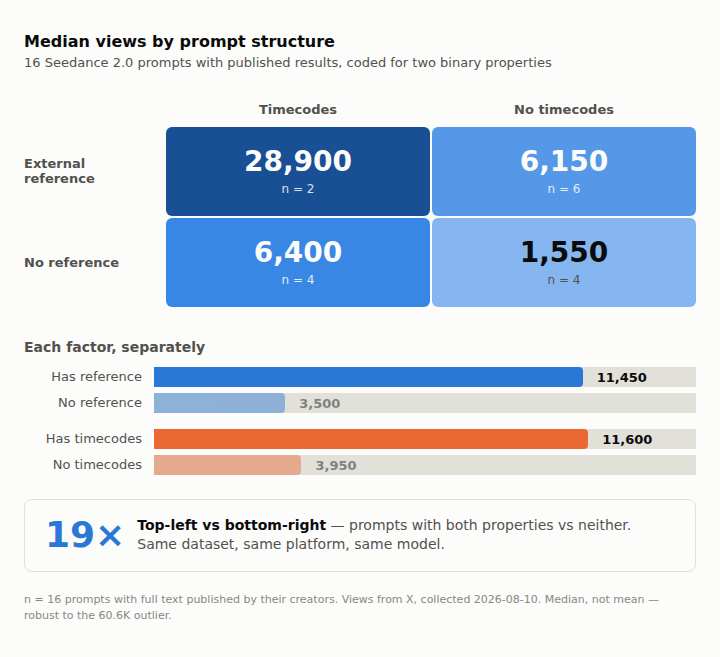
The gradient is monotonic in both directions, and the two corners differ by roughly 19×.
Taken separately, each factor also separates cleanly:
| Property | n | Median views |
|---|---|---|
| Has external reference | 8 | 11,450 |
| No external reference | 8 | 3,500 |
| Has timecodes | 6 | 11,600 |
| No timecodes | 10 | 3,950 |
Among the top 5 entries, 4 use an external reference and 3 use timecodes. Among the bottom 5: 1 and 1.
The one comparison that controls for audience
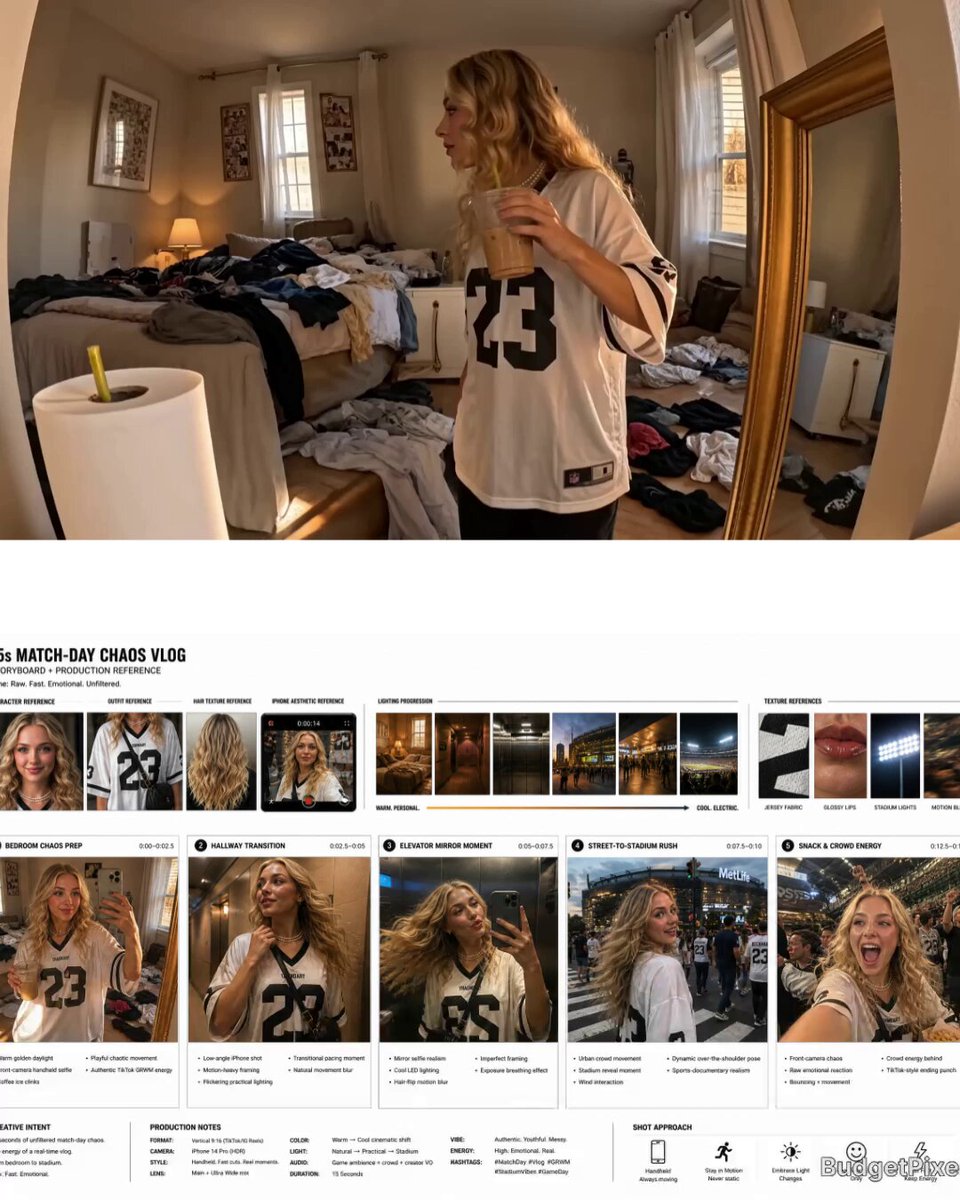
The single most useful data point is that one creator, @Just_sharon7, appears twice with two structurally different prompts:
- Influencer vlog — locked reference character, six storyboard shots, each with an explicit time span and its own audio block → 43,100 views
- MJ vs Ritchson — three timecoded cuts, richly described, but no external reference and no per-shot lock → 8,500 views
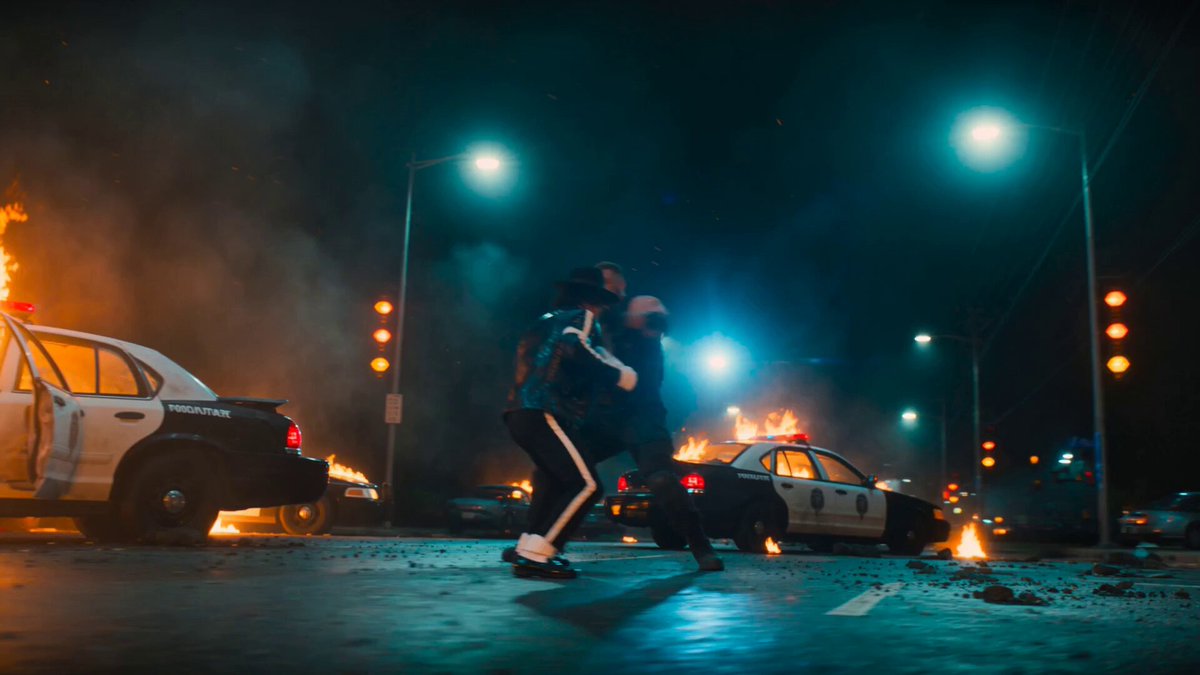
Same creator, same audience, same platform, roughly two weeks apart. 5.1×.
One pair proves nothing on its own. But it's the only comparison in the set where the largest confound is held approximately constant, and it points the same direction as the aggregate.
What length does not predict
If "more detail" were the mechanism, prompt length should track performance. It doesn't:
| Prompt chars | Views | Entry |
|---|---|---|
| 4,200 | 43,100 | Influencer vlog storyboard |
| 2,600 | 60,600 | Tom and Jerry photoreal |
| 3,300 | 8,200 | Asian contemporary dance |
| 2,500 | 1,700 | Haunted train anime |
| 1,000 | 1,500 | Storm Emperor |
| 280 | 4,100 | Beat-synced outfit swap |
| 85 | 895 | WW2 motorcycle |
A 2,500-character prompt landed 1,700 views. A 280-character prompt landed 4,100. The 85-character entry — create a cinematic WW2 motorcycle escape sequence that makes sora and veo question their existence — is the shortest and the worst-performing, but the correlation breaks immediately above it.
Length is not the variable. Where the information comes from is the variable.
Why constraint would beat description
Here is the mechanism I think the numbers are pointing at.
A description leaves the model free on every axis you didn't mention — and in video, the axes you didn't mention include everything that changes between frame 1 and frame 360. The failure modes people complain about in text-to-video are almost all temporal: identity drift, wandering camera, pacing that ignores your intended beat, a subject that silently becomes a different person at the cut.
Prose cannot pin those down, because prose has no coordinate system for time. You can write "cinematic slow motion, dramatic pacing" and the model has no way to know that you meant the reveal lands at second 9.
Both winning properties do the same thing from different sides:
- A timecode partitions the time axis. Instead of one 15-second generation problem with unconstrained internal structure, you hand the model six labeled 2-to-3-second problems. Ambiguity gets bounded inside each span rather than compounding across the whole clip.
- An external reference removes the axis from the prompt entirely. "Use the uploaded reference video as the master reference. Maintain the EXACT camera movement, lens, framing, composition, timing, pacing, shot transitions." That prompt isn't describing a camera move — it's delegating the camera move to an artifact that already contains it, losslessly.
The 60,600-view entry is the purest example. It is barely a creative prompt at all. It's a transfer specification: keep the source frame-by-frame, replace exactly two entities, change nothing else — followed by a long explicit list of what must not drift (No identity drift. No fur color changes. No eye color changes. No anatomy deformation.).

The generative freedom in that prompt is close to zero. That appears to be the point.
The pattern nobody is writing about: generate the constraint first
The most interesting thing in the dataset isn't a prompt technique. It's a two-stage workflow that shows up independently in four entries, three of which are in the top five.
The creator doesn't prompt for a video. They first prompt for a structured instruction artifact — then use that artifact as the external reference for the video pass.
@john_my07(54,900) generates a 4×4 grid, 16 numbered panels, each with a step title, a full-body pose, 3–4 lines of instruction, and directional motion arrows — as an image — then animates from it.
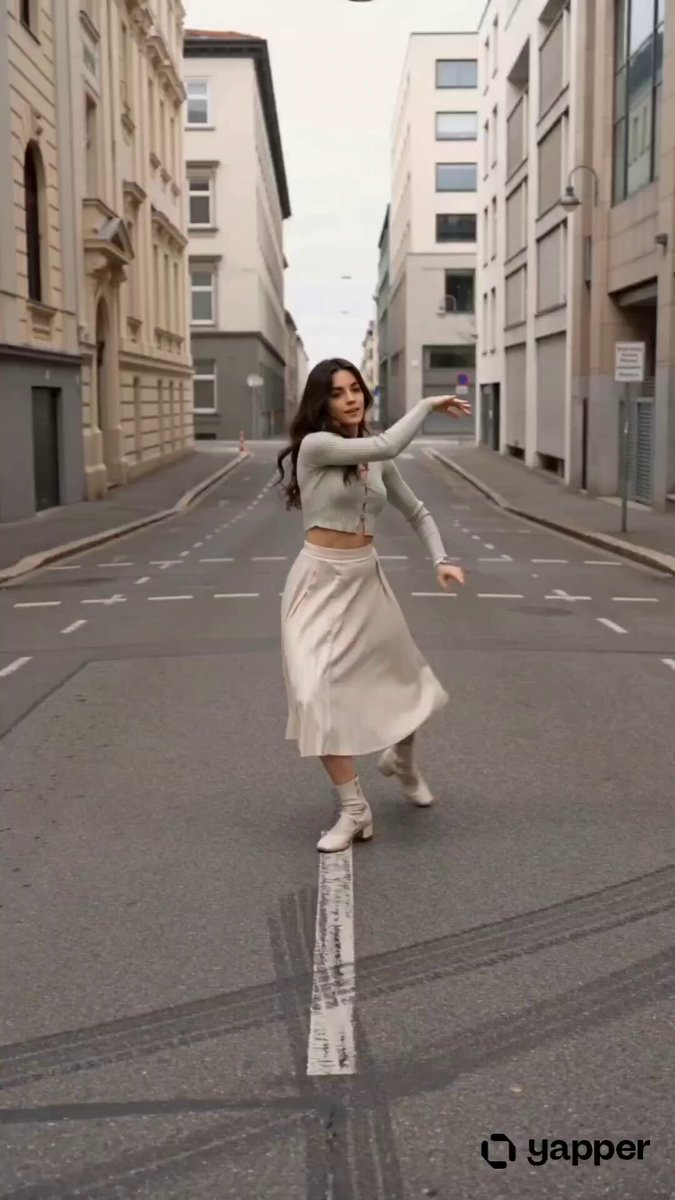
@miilesus(3,800) uses the same 16-panel scaffold for K-pop choreography.@Shorelyn_(14,700) generates a 10-frame commercial storyboard on a 2×5 presentation board, each panel carrying a scene number, a timestamp, and a production caption, before producing the film.

@aimikoda(8,200) writes explicit per-panel blocking (P01–P12), each specifying camera height, subject placement in frame, and the movement into the next beat.
This is the same insight as the headline finding, applied recursively: if the model performs better when constrained by an external artifact, use the model to manufacture the artifact. You get a reference for free, without a camera, without a designer, and without leaving the tool.
It also gives you something the one-shot approach can't: an inspectable intermediate. A bad storyboard panel is visible and cheap to regenerate. A bad second 7 of a finished video is neither.
Two things worth dropping
Midjourney flags. One prompt in the set ends with --ar 16:9 --v 6 --stylize 250 --seed 42 --character_ref "MJ_1987, Ritchson_ReacherS1". That's Midjourney parameter syntax carried into a Seedance prompt. Whatever it does here, it isn't doing what those flags do in the tool they came from — and --character_ref in particular is being asked to carry identity-locking work that the prompt body never states. If you need identity locked, write the lock out in full, the way the 60,600-view entry does.
Negative prompts. Only 2 of 16 use a trailing negative block. It's too thin to conclude anything, and I'm noting it mainly because guides treat negatives as a core technique while working creators here mostly don't bother. Worth its own test rather than an assertion.
How to use this
If the finding generalizes, the practical ordering is:
- Can you supply a reference? A source video, a source image, a storyboard, a pose sheet. If yes, supply it, and spend your prompt on what must be preserved rather than what should be created.
- If you can't, generate one. Ask for a numbered panel grid or a storyboard board first. Inspect it. Then animate from it.
- Partition the duration explicitly. Label spans. Give each span its own camera, its own action, and — if the model accepts it — its own audio.
- Spend your character budget on locks, not adjectives. A repeated, unchanging character block beats another sentence of atmosphere.
- Stop optimizing length. It isn't the variable.
Reproducing and disputing this
The collection, with every prompt, clip, creator credit, and view count, is public: awesome-seedance-prompts. Coding a prompt for "has an external reference" and "has timecodes" takes about a minute per entry, so the classification above is easy to check and easy to disagree with.
The obvious next step is a controlled version: same subject, same creator, same posting conditions, four prompts spanning the 2×2. That removes the audience confound this dataset can't. If you run it, I'd like to see the result — including if it comes out flat.
I built Seedance Prompt Studio partly to make the structural pattern above the default rather than something you have to remember: it emits timecoded, slot-structured prompts and carries a subject anchor across shots so identity doesn't drift at the cut. If you'd rather just run the models with a front-end already attached, seadanse.com has them.
Data collected 2026-08-10 from public X posts. All prompts are reproduced with creator attribution; view counts are as reported by X at collection time and will have moved since.