
Get trending papers in your email inbox once a day!
Get trending papers in your email inbox!
Subscribe
Synthesizing the preferred inputs for neurons in neural networks via deep generator networks
Deep neural networks (DNNs) have demonstrated state-of-the-art results on many pattern recognition tasks, especially vision classification problems. Understanding the inner workings of such computational brains is both fascinating basic science that is interesting in its own right - similar to why we study the human brain - and will enable researchers to further improve DNNs. One path to understanding how a neural network functions internally is to study what each of its neurons has learned to detect. One such method is called activation maximization (AM), which synthesizes an input (e.g. an image) that highly activates a neuron. Here we dramatically improve the qualitative state of the art of activation maximization by harnessing a powerful, learned prior: a deep generator network (DGN). The algorithm (1) generates qualitatively state-of-the-art synthetic images that look almost real, (2) reveals the features learned by each neuron in an interpretable way, (3) generalizes well to new datasets and somewhat well to different network architectures without requiring the prior to be relearned, and (4) can be considered as a high-quality generative method (in this case, by generating novel, creative, interesting, recognizable images).

Understanding Neural Networks via Feature Visualization: A survey
A neuroscience method to understanding the brain is to find and study the preferred stimuli that highly activate an individual cell or groups of cells. Recent advances in machine learning enable a family of methods to synthesize preferred stimuli that cause a neuron in an artificial or biological brain to fire strongly. Those methods are known as Activation Maximization (AM) or Feature Visualization via Optimization. In this chapter, we (1) review existing AM techniques in the literature; (2) discuss a probabilistic interpretation for AM; and (3) review the applications of AM in debugging and explaining networks.
Graph Metanetworks for Processing Diverse Neural Architectures
Neural networks efficiently encode learned information within their parameters. Consequently, many tasks can be unified by treating neural networks themselves as input data. When doing so, recent studies demonstrated the importance of accounting for the symmetries and geometry of parameter spaces. However, those works developed architectures tailored to specific networks such as MLPs and CNNs without normalization layers, and generalizing such architectures to other types of networks can be challenging. In this work, we overcome these challenges by building new metanetworks - neural networks that take weights from other neural networks as input. Put simply, we carefully build graphs representing the input neural networks and process the graphs using graph neural networks. Our approach, Graph Metanetworks (GMNs), generalizes to neural architectures where competing methods struggle, such as multi-head attention layers, normalization layers, convolutional layers, ResNet blocks, and group-equivariant linear layers. We prove that GMNs are expressive and equivariant to parameter permutation symmetries that leave the input neural network functions unchanged. We validate the effectiveness of our method on several metanetwork tasks over diverse neural network architectures.



Probabilistic Artificial Intelligence
Artificial intelligence commonly refers to the science and engineering of artificial systems that can carry out tasks generally associated with requiring aspects of human intelligence, such as playing games, translating languages, and driving cars. In recent years, there have been exciting advances in learning-based, data-driven approaches towards AI, and machine learning and deep learning have enabled computer systems to perceive the world in unprecedented ways. Reinforcement learning has enabled breakthroughs in complex games such as Go and challenging robotics tasks such as quadrupedal locomotion. A key aspect of intelligence is to not only make predictions, but reason about the uncertainty in these predictions, and to consider this uncertainty when making decisions. This is what this manuscript on "Probabilistic Artificial Intelligence" is about. The first part covers probabilistic approaches to machine learning. We discuss the differentiation between "epistemic" uncertainty due to lack of data and "aleatoric" uncertainty, which is irreducible and stems, e.g., from noisy observations and outcomes. We discuss concrete approaches towards probabilistic inference and modern approaches to efficient approximate inference. The second part of the manuscript is about taking uncertainty into account in sequential decision tasks. We consider active learning and Bayesian optimization -- approaches that collect data by proposing experiments that are informative for reducing the epistemic uncertainty. We then consider reinforcement learning and modern deep RL approaches that use neural network function approximation. We close by discussing modern approaches in model-based RL, which harness epistemic and aleatoric uncertainty to guide exploration, while also reasoning about safety.

Distributionally Robust Receive Beamforming
This article investigates signal estimation in wireless transmission (i.e., receive beamforming) from the perspective of statistical machine learning, where the transmit signals may be from an integrated sensing and communication system; that is, 1) signals may be not only discrete constellation points but also arbitrary complex values; 2) signals may be spatially correlated. Particular attention is paid to handling various uncertainties such as the uncertainty of the transmit signal covariance, the uncertainty of the channel matrix, the uncertainty of the channel noise covariance, the existence of channel impulse noises, and the limited sample size of pilots. To proceed, a distributionally robust machine learning framework that is insensitive to the above uncertainties is proposed, which reveals that channel estimation is not a necessary operation. For optimal linear estimation, the proposed framework includes several existing beamformers as special cases such as diagonal loading and eigenvalue thresholding. For optimal nonlinear estimation, estimators are limited in reproducing kernel Hilbert spaces and neural network function spaces, and corresponding uncertainty-aware solutions (e.g., kernelized diagonal loading) are derived. In addition, we prove that the ridge and kernel ridge regression methods in machine learning are distributionally robust against diagonal perturbation in feature covariance.
On gauge freedom, conservativity and intrinsic dimensionality estimation in diffusion models
Diffusion models are generative models that have recently demonstrated impressive performances in terms of sampling quality and density estimation in high dimensions. They rely on a forward continuous diffusion process and a backward continuous denoising process, which can be described by a time-dependent vector field and is used as a generative model. In the original formulation of the diffusion model, this vector field is assumed to be the score function (i.e. it is the gradient of the log-probability at a given time in the diffusion process). Curiously, on the practical side, most studies on diffusion models implement this vector field as a neural network function and do not constrain it be the gradient of some energy function (that is, most studies do not constrain the vector field to be conservative). Even though some studies investigated empirically whether such a constraint will lead to a performance gain, they lead to contradicting results and failed to provide analytical results. Here, we provide three analytical results regarding the extent of the modeling freedom of this vector field. {Firstly, we propose a novel decomposition of vector fields into a conservative component and an orthogonal component which satisfies a given (gauge) freedom. Secondly, from this orthogonal decomposition, we show that exact density estimation and exact sampling is achieved when the conservative component is exactly equals to the true score and therefore conservativity is neither necessary nor sufficient to obtain exact density estimation and exact sampling. Finally, we show that when it comes to inferring local information of the data manifold, constraining the vector field to be conservative is desirable.
The Benefits of Model-Based Generalization in Reinforcement Learning
Model-Based Reinforcement Learning (RL) is widely believed to have the potential to improve sample efficiency by allowing an agent to synthesize large amounts of imagined experience. Experience Replay (ER) can be considered a simple kind of model, which has proved extremely effective at improving the stability and efficiency of deep RL. In principle, a learned parametric model could improve on ER by generalizing from real experience to augment the dataset with additional plausible experience. However, owing to the many design choices involved in empirically successful algorithms, it can be very hard to establish where the benefits are actually coming from. Here, we provide theoretical and empirical insight into when, and how, we can expect data generated by a learned model to be useful. First, we provide a general theorem motivating how learning a model as an intermediate step can narrow down the set of possible value functions more than learning a value function directly from data using the Bellman equation. Second, we provide an illustrative example showing empirically how a similar effect occurs in a more concrete setting with neural network function approximation. Finally, we provide extensive experiments showing the benefit of model-based learning for online RL in environments with combinatorial complexity, but factored structure that allows a learned model to generalize. In these experiments, we take care to control for other factors in order to isolate, insofar as possible, the benefit of using experience generated by a learned model relative to ER alone.

Unification of popular artificial neural network activation functions
We present a unified representation of the most popular neural network activation functions. Adopting Mittag-Leffler functions of fractional calculus, we propose a flexible and compact functional form that is able to interpolate between various activation functions and mitigate common problems in training neural networks such as vanishing and exploding gradients. The presented gated representation extends the scope of fixed-shape activation functions to their adaptive counterparts whose shape can be learnt from the training data. The derivatives of the proposed functional form can also be expressed in terms of Mittag-Leffler functions making it a suitable candidate for gradient-based backpropagation algorithms. By training multiple neural networks of different complexities on various datasets with different sizes, we demonstrate that adopting a unified gated representation of activation functions offers a promising and affordable alternative to individual built-in implementations of activation functions in conventional machine learning frameworks.

Gaussian Error Linear Units (GELUs)
We propose the Gaussian Error Linear Unit (GELU), a high-performing neural network activation function. The GELU activation function is xPhi(x), where Phi(x) the standard Gaussian cumulative distribution function. The GELU nonlinearity weights inputs by their value, rather than gates inputs by their sign as in ReLUs (x1_{x>0}). We perform an empirical evaluation of the GELU nonlinearity against the ReLU and ELU activations and find performance improvements across all considered computer vision, natural language processing, and speech tasks.
Extending Deep Reinforcement Learning Frameworks in Cryptocurrency Market Making
There has been a recent surge in interest in the application of artificial intelligence to automated trading. Reinforcement learning has been applied to single- and multi-instrument use cases, such as market making or portfolio management. This paper proposes a new approach to framing cryptocurrency market making as a reinforcement learning challenge by introducing an event-based environment wherein an event is defined as a change in price greater or less than a given threshold, as opposed to by tick or time-based events (e.g., every minute, hour, day, etc.). Two policy-based agents are trained to learn a market making trading strategy using eight days of training data and evaluate their performance using 30 days of testing data. Limit order book data recorded from Bitmex exchange is used to validate this approach, which demonstrates improved profit and stability compared to a time-based approach for both agents when using a simple multi-layer perceptron neural network for function approximation and seven different reward functions.

Lite-RVFL: A Lightweight Random Vector Functional-Link Neural Network for Learning Under Concept Drift
The change in data distribution over time, also known as concept drift, poses a significant challenge to the reliability of online learning methods. Existing methods typically require model retraining or drift detection, both of which demand high computational costs and are often unsuitable for real-time applications. To address these limitations, a lightweight, fast and efficient random vector functional-link network termed Lite-RVFL is proposed, capable of adapting to concept drift without drift detection and retraining. Lite-RVFL introduces a novel objective function that assigns weights exponentially increasing to new samples, thereby emphasizing recent data and enabling timely adaptation. Theoretical analysis confirms the feasibility of this objective function for drift adaptation, and an efficient incremental update rule is derived. Experimental results on a real-world safety assessment task validate the efficiency, effectiveness in adapting to drift, and potential to capture temporal patterns of Lite-RVFL. The source code is available at https://github.com/songqiaohu/Lite-RVFL.
Generalizing Neural Wave Functions
Recent neural network-based wave functions have achieved state-of-the-art accuracies in modeling ab-initio ground-state potential energy surface. However, these networks can only solve different spatial arrangements of the same set of atoms. To overcome this limitation, we present Graph-learned orbital embeddings (Globe), a neural network-based reparametrization method that can adapt neural wave functions to different molecules. Globe learns representations of local electronic structures that generalize across molecules via spatial message passing by connecting molecular orbitals to covalent bonds. Further, we propose a size-consistent wave function Ansatz, the Molecular orbital network (Moon), tailored to jointly solve Schr\"odinger equations of different molecules. In our experiments, we find Moon converging in 4.5 times fewer steps to similar accuracy as previous methods or to lower energies given the same time. Further, our analysis shows that Moon's energy estimate scales additively with increased system sizes, unlike previous work where we observe divergence. In both computational chemistry and machine learning, we are the first to demonstrate that a single wave function can solve the Schr\"odinger equation of molecules with different atoms jointly.
On weight initialization in deep neural networks
A proper initialization of the weights in a neural network is critical to its convergence. Current insights into weight initialization come primarily from linear activation functions. In this paper, I develop a theory for weight initializations with non-linear activations. First, I derive a general weight initialization strategy for any neural network using activation functions differentiable at 0. Next, I derive the weight initialization strategy for the Rectified Linear Unit (RELU), and provide theoretical insights into why the Xavier initialization is a poor choice with RELU activations. My analysis provides a clear demonstration of the role of non-linearities in determining the proper weight initializations.
Boosting Reservoir Computing with Brain-inspired Adaptive Dynamics
Reservoir computers (RCs) provide a computationally efficient alternative to deep learning while also offering a framework for incorporating brain-inspired computational principles. By using an internal neural network with random, fixed connections-the 'reservoir'-and training only the output weights, RCs simplify the training process but remain sensitive to the choice of hyperparameters that govern activation functions and network architecture. Moreover, typical RC implementations overlook a critical aspect of neuronal dynamics: the balance between excitatory and inhibitory (E-I) signals, which is essential for robust brain function. We show that RCs characteristically perform best in balanced or slightly over-inhibited regimes, outperforming excitation-dominated ones. To reduce the need for precise hyperparameter tuning, we introduce a self-adapting mechanism that locally adjusts E/I balance to achieve target neuronal firing rates, improving performance by up to 130% in tasks like memory capacity and time series prediction compared with globally tuned RCs. Incorporating brain-inspired heterogeneity in target neuronal firing rates further reduces the need for fine-tuning hyperparameters and enables RCs to excel across linear and non-linear tasks. These results support a shift from static optimization to dynamic adaptation in reservoir design, demonstrating how brain-inspired mechanisms improve RC performance and robustness while deepening our understanding of neural computation.
Developing an Optimal Model for Predicting the Severity of Wheat Stem Rust (Case study of Arsi and Bale Zone)
This research utilized three types of artificial neural network (ANN) methodologies, namely Backpropagation Neural Network (BPNN) with varied training, transfer, divide, and learning functions; Radial Basis Function Neural Network (RBFNN); and General Regression Neural Network (GRNN), to forecast the severity of stem rust. It considered parameters such as mean maximum temperature, mean minimum temperature, mean rainfall, mean average temperature, mean relative humidity, and different wheat varieties. The statistical analysis revealed that GRNN demonstrated effective predictive capability and required less training time compared to the other models. Additionally, the results indicated that total seasonal rainfall positively influenced the development of wheat stem rust. Keywords: Wheat stem rust, Back propagation neural network, Radial Basis Function Neural Network, General Regression Neural Network.
How Do Training Methods Influence the Utilization of Vision Models?
Not all learnable parameters (e.g., weights) contribute equally to a neural network's decision function. In fact, entire layers' parameters can sometimes be reset to random values with little to no impact on the model's decisions. We revisit earlier studies that examined how architecture and task complexity influence this phenomenon and ask: is this phenomenon also affected by how we train the model? We conducted experimental evaluations on a diverse set of ImageNet-1k classification models to explore this, keeping the architecture and training data constant but varying the training pipeline. Our findings reveal that the training method strongly influences which layers become critical to the decision function for a given task. For example, improved training regimes and self-supervised training increase the importance of early layers while significantly under-utilizing deeper layers. In contrast, methods such as adversarial training display an opposite trend. Our preliminary results extend previous findings, offering a more nuanced understanding of the inner mechanics of neural networks. Code: https://github.com/paulgavrikov/layer_criticality



Geographic Location Encoding with Spherical Harmonics and Sinusoidal Representation Networks
Learning feature representations of geographical space is vital for any machine learning model that integrates geolocated data, spanning application domains such as remote sensing, ecology, or epidemiology. Recent work mostly embeds coordinates using sine and cosine projections based on Double Fourier Sphere (DFS) features -- these embeddings assume a rectangular data domain even on global data, which can lead to artifacts, especially at the poles. At the same time, relatively little attention has been paid to the exact design of the neural network architectures these functional embeddings are combined with. This work proposes a novel location encoder for globally distributed geographic data that combines spherical harmonic basis functions, natively defined on spherical surfaces, with sinusoidal representation networks (SirenNets) that can be interpreted as learned Double Fourier Sphere embedding. We systematically evaluate the cross-product of positional embeddings and neural network architectures across various classification and regression benchmarks and synthetic evaluation datasets. In contrast to previous approaches that require the combination of both positional encoding and neural networks to learn meaningful representations, we show that both spherical harmonics and sinusoidal representation networks are competitive on their own but set state-of-the-art performances across tasks when combined. We provide source code at www.github.com/marccoru/locationencoder

Neural network emulator to constrain the high-$z$ IGM thermal state from Lyman-$α$ forest flux auto-correlation function
We present a neural network emulator to constrain the thermal parameters of the intergalactic medium (IGM) at 5.4z6.0 using the Lyman-displaystylealpha (Lydisplaystylealpha) forest flux auto-correlation function. Our auto-differentiable JAX-based framework accelerates the surrogate model generation process using approximately 100 sparsely sampled Nyx hydrodynamical simulations with varying combinations of thermal parameters, i.e., the temperature at mean density T_{{0}}, the slope of the temperaturedisplaystyle-density relation displaystylegamma, and the mean transmission flux langle{F}{rangle}. We show that this emulator has a typical accuracy of 1.0% across the specified redshift range. Bayesian inference of the IGM thermal parameters, incorporating emulator uncertainty propagation, is further expedited using NumPyro Hamiltonian Monte Carlo. We compare both the inference results and computational cost of our framework with the traditional nearest-neighbor interpolation approach applied to the same set of mock Lyalpha flux. By examining the credibility contours of the marginalized posteriors for T_{{0}},gamma,and{langle}{F}{rangle} obtained using the emulator, the statistical reliability of measurements is established through inference on 100 realistic mock data sets of the auto-correlation function.

Learning Rates as a Function of Batch Size: A Random Matrix Theory Approach to Neural Network Training
We study the effect of mini-batching on the loss landscape of deep neural networks using spiked, field-dependent random matrix theory. We demonstrate that the magnitude of the extremal values of the batch Hessian are larger than those of the empirical Hessian. We also derive similar results for the Generalised Gauss-Newton matrix approximation of the Hessian. As a consequence of our theorems we derive an analytical expressions for the maximal learning rates as a function of batch size, informing practical training regimens for both stochastic gradient descent (linear scaling) and adaptive algorithms, such as Adam (square root scaling), for smooth, non-convex deep neural networks. Whilst the linear scaling for stochastic gradient descent has been derived under more restrictive conditions, which we generalise, the square root scaling rule for adaptive optimisers is, to our knowledge, completely novel. %For stochastic second-order methods and adaptive methods, we derive that the minimal damping coefficient is proportional to the ratio of the learning rate to batch size. We validate our claims on the VGG/WideResNet architectures on the CIFAR-100 and ImageNet datasets. Based on our investigations of the sub-sampled Hessian we develop a stochastic Lanczos quadrature based on the fly learning rate and momentum learner, which avoids the need for expensive multiple evaluations for these key hyper-parameters and shows good preliminary results on the Pre-Residual Architecure for CIFAR-100.
Neural Network Approximations of PDEs Beyond Linearity: A Representational Perspective
A burgeoning line of research leverages deep neural networks to approximate the solutions to high dimensional PDEs, opening lines of theoretical inquiry focused on explaining how it is that these models appear to evade the curse of dimensionality. However, most prior theoretical analyses have been limited to linear PDEs. In this work, we take a step towards studying the representational power of neural networks for approximating solutions to nonlinear PDEs. We focus on a class of PDEs known as nonlinear elliptic variational PDEs, whose solutions minimize an Euler-Lagrange energy functional E(u) = int_Omega L(x, u(x), nabla u(x)) - f(x) u(x)dx. We show that if composing a function with Barron norm b with partial derivatives of L produces a function of Barron norm at most B_L b^p, the solution to the PDE can be epsilon-approximated in the L^2 sense by a function with Barron norm Oleft(left(dB_Lright)^{max{p log(1/ epsilon), p^{log(1/epsilon)}}}right). By a classical result due to Barron [1993], this correspondingly bounds the size of a 2-layer neural network needed to approximate the solution. Treating p, epsilon, B_L as constants, this quantity is polynomial in dimension, thus showing neural networks can evade the curse of dimensionality. Our proof technique involves neurally simulating (preconditioned) gradient in an appropriate Hilbert space, which converges exponentially fast to the solution of the PDE, and such that we can bound the increase of the Barron norm at each iterate. Our results subsume and substantially generalize analogous prior results for linear elliptic PDEs over a unit hypercube.
The boundary of neural network trainability is fractal
Some fractals -- for instance those associated with the Mandelbrot and quadratic Julia sets -- are computed by iterating a function, and identifying the boundary between hyperparameters for which the resulting series diverges or remains bounded. Neural network training similarly involves iterating an update function (e.g. repeated steps of gradient descent), can result in convergent or divergent behavior, and can be extremely sensitive to small changes in hyperparameters. Motivated by these similarities, we experimentally examine the boundary between neural network hyperparameters that lead to stable and divergent training. We find that this boundary is fractal over more than ten decades of scale in all tested configurations.

Neural Network Quine
Self-replication is a key aspect of biological life that has been largely overlooked in Artificial Intelligence systems. Here we describe how to build and train self-replicating neural networks. The network replicates itself by learning to output its own weights. The network is designed using a loss function that can be optimized with either gradient-based or non-gradient-based methods. We also describe a method we call regeneration to train the network without explicit optimization, by injecting the network with predictions of its own parameters. The best solution for a self-replicating network was found by alternating between regeneration and optimization steps. Finally, we describe a design for a self-replicating neural network that can solve an auxiliary task such as MNIST image classification. We observe that there is a trade-off between the network's ability to classify images and its ability to replicate, but training is biased towards increasing its specialization at image classification at the expense of replication. This is analogous to the trade-off between reproduction and other tasks observed in nature. We suggest that a self-replication mechanism for artificial intelligence is useful because it introduces the possibility of continual improvement through natural selection.
Neural Network Verification with Branch-and-Bound for General Nonlinearities
Branch-and-bound (BaB) is among the most effective techniques for neural network (NN) verification. However, existing works on BaB for NN verification have mostly focused on NNs with piecewise linear activations, especially ReLU networks. In this paper, we develop a general framework, named GenBaB, to conduct BaB on general nonlinearities to verify NNs with general architectures, based on linear bound propagation for NN verification. To decide which neuron to branch, we design a new branching heuristic which leverages linear bounds as shortcuts to efficiently estimate the potential improvement after branching. To decide nontrivial branching points for general nonlinear functions, we propose to pre-optimize branching points, which can be efficiently leveraged during verification with a lookup table. We demonstrate the effectiveness of our GenBaB on verifying a wide range of NNs, including NNs with activation functions such as Sigmoid, Tanh, Sine and GeLU, as well as NNs involving multi-dimensional nonlinear operations such as multiplications in LSTMs and Vision Transformers. Our framework also allows the verification of general nonlinear computation graphs and enables verification applications beyond simple NNs, particularly for AC Optimal Power Flow (ACOPF). GenBaB is part of the latest alpha,!beta-CROWN, the winner of the 4th and the 5th International Verification of Neural Networks Competition (VNN-COMP 2023 and 2024).

Neural Network-Based Score Estimation in Diffusion Models: Optimization and Generalization
Diffusion models have emerged as a powerful tool rivaling GANs in generating high-quality samples with improved fidelity, flexibility, and robustness. A key component of these models is to learn the score function through score matching. Despite empirical success on various tasks, it remains unclear whether gradient-based algorithms can learn the score function with a provable accuracy. As a first step toward answering this question, this paper establishes a mathematical framework for analyzing score estimation using neural networks trained by gradient descent. Our analysis covers both the optimization and the generalization aspects of the learning procedure. In particular, we propose a parametric form to formulate the denoising score-matching problem as a regression with noisy labels. Compared to the standard supervised learning setup, the score-matching problem introduces distinct challenges, including unbounded input, vector-valued output, and an additional time variable, preventing existing techniques from being applied directly. In this paper, we show that with proper designs, the evolution of neural networks during training can be accurately modeled by a series of kernel regression tasks. Furthermore, by applying an early-stopping rule for gradient descent and leveraging recent developments in neural tangent kernels, we establish the first generalization error (sample complexity) bounds for learning the score function with neural networks, despite the presence of noise in the observations. Our analysis is grounded in a novel parametric form of the neural network and an innovative connection between score matching and regression analysis, facilitating the application of advanced statistical and optimization techniques.
A Generalized Bandsplit Neural Network for Cinematic Audio Source Separation
Cinematic audio source separation is a relatively new subtask of audio source separation, with the aim of extracting the dialogue, music, and effects stems from their mixture. In this work, we developed a model generalizing the Bandsplit RNN for any complete or overcomplete partitions of the frequency axis. Psychoacoustically motivated frequency scales were used to inform the band definitions which are now defined with redundancy for more reliable feature extraction. A loss function motivated by the signal-to-noise ratio and the sparsity-promoting property of the 1-norm was proposed. We additionally exploit the information-sharing property of a common-encoder setup to reduce computational complexity during both training and inference, improve separation performance for hard-to-generalize classes of sounds, and allow flexibility during inference time with detachable decoders. Our best model sets the state of the art on the Divide and Remaster dataset with performance above the ideal ratio mask for the dialogue stem.


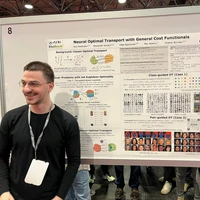
Neural Optimal Transport with General Cost Functionals
We introduce a novel neural network-based algorithm to compute optimal transport (OT) plans for general cost functionals. In contrast to common Euclidean costs, i.e., ell^1 or ell^2, such functionals provide more flexibility and allow using auxiliary information, such as class labels, to construct the required transport map. Existing methods for general costs are discrete and have limitations in practice, i.e. they do not provide an out-of-sample estimation. We address the challenge of designing a continuous OT approach for general costs that generalizes to new data points in high-dimensional spaces, such as images. Additionally, we provide the theoretical error analysis for our recovered transport plans. As an application, we construct a cost functional to map data distributions while preserving the class-wise structure.
Neural networks with trainable matrix activation functions
The training process of neural networks usually optimize weights and bias parameters of linear transformations, while nonlinear activation functions are pre-specified and fixed. This work develops a systematic approach to constructing matrix activation functions whose entries are generalized from ReLU. The activation is based on matrix-vector multiplications using only scalar multiplications and comparisons. The proposed activation functions depend on parameters that are trained along with the weights and bias vectors. Neural networks based on this approach are simple and efficient and are shown to be robust in numerical experiments.
LayerMerge: Neural Network Depth Compression through Layer Pruning and Merging
Recent works show that reducing the number of layers in a convolutional neural network can enhance efficiency while maintaining the performance of the network. Existing depth compression methods remove redundant non-linear activation functions and merge the consecutive convolution layers into a single layer. However, these methods suffer from a critical drawback; the kernel size of the merged layers becomes larger, significantly undermining the latency reduction gained from reducing the depth of the network. We show that this problem can be addressed by jointly pruning convolution layers and activation functions. To this end, we propose LayerMerge, a novel depth compression method that selects which activation layers and convolution layers to remove, to achieve a desired inference speed-up while minimizing performance loss. Since the corresponding selection problem involves an exponential search space, we formulate a novel surrogate optimization problem and efficiently solve it via dynamic programming. Empirical results demonstrate that our method consistently outperforms existing depth compression and layer pruning methods on various network architectures, both on image classification and generation tasks. We release the code at https://github.com/snu-mllab/LayerMerge.


Going Beyond Neural Network Feature Similarity: The Network Feature Complexity and Its Interpretation Using Category Theory
The behavior of neural networks still remains opaque, and a recently widely noted phenomenon is that networks often achieve similar performance when initialized with different random parameters. This phenomenon has attracted significant attention in measuring the similarity between features learned by distinct networks. However, feature similarity could be vague in describing the same feature since equivalent features hardly exist. In this paper, we expand the concept of equivalent feature and provide the definition of what we call functionally equivalent features. These features produce equivalent output under certain transformations. Using this definition, we aim to derive a more intrinsic metric for the so-called feature complexity regarding the redundancy of features learned by a neural network at each layer. We offer a formal interpretation of our approach through the lens of category theory, a well-developed area in mathematics. To quantify the feature complexity, we further propose an efficient algorithm named Iterative Feature Merging. Our experimental results validate our ideas and theories from various perspectives. We empirically demonstrate that the functionally equivalence widely exists among different features learned by the same neural network and we could reduce the number of parameters of the network without affecting the performance.The IFM shows great potential as a data-agnostic model prune method. We have also drawn several interesting empirical findings regarding the defined feature complexity.
Graph Neural Network based Agent in Google Research Football
Deep neural networks (DNN) can approximate value functions or policies for reinforcement learning, which makes the reinforcement learning algorithms more powerful. However, some DNNs, such as convolutional neural networks (CNN), cannot extract enough information or take too long to obtain enough features from the inputs under specific circumstances of reinforcement learning. For example, the input data of Google Research Football, a reinforcement learning environment which trains agents to play football, is the small map of players' locations. The information is contained not only in the coordinates of players, but also in the relationships between different players. CNNs can neither extract enough information nor take too long to train. To address this issue, this paper proposes a deep q-learning network (DQN) with a graph neural network (GNN) as its model. The GNN transforms the input data into a graph which better represents the football players' locations so that it extracts more information of the interactions between different players. With two GNNs to approximate its local and target value functions, this DQN allows players to learn from their experience by using value functions to see the prospective value of each intended action. The proposed model demonstrated the power of GNN in the football game by outperforming other DRL models with significantly fewer steps.

A Diversity-Promoting Objective Function for Neural Conversation Models
Sequence-to-sequence neural network models for generation of conversational responses tend to generate safe, commonplace responses (e.g., "I don't know") regardless of the input. We suggest that the traditional objective function, i.e., the likelihood of output (response) given input (message) is unsuited to response generation tasks. Instead we propose using Maximum Mutual Information (MMI) as the objective function in neural models. Experimental results demonstrate that the proposed MMI models produce more diverse, interesting, and appropriate responses, yielding substantive gains in BLEU scores on two conversational datasets and in human evaluations.

Equivariant Matrix Function Neural Networks
Graph Neural Networks (GNNs), especially message-passing neural networks (MPNNs), have emerged as powerful architectures for learning on graphs in diverse applications. However, MPNNs face challenges when modeling non-local interactions in graphs such as large conjugated molecules, and social networks due to oversmoothing and oversquashing. Although Spectral GNNs and traditional neural networks such as recurrent neural networks and transformers mitigate these challenges, they often lack generalizability, or fail to capture detailed structural relationships or symmetries in the data. To address these concerns, we introduce Matrix Function Neural Networks (MFNs), a novel architecture that parameterizes non-local interactions through analytic matrix equivariant functions. Employing resolvent expansions offers a straightforward implementation and the potential for linear scaling with system size. The MFN architecture achieves stateof-the-art performance in standard graph benchmarks, such as the ZINC and TU datasets, and is able to capture intricate non-local interactions in quantum systems, paving the way to new state-of-the-art force fields.

DyCL: Dynamic Neural Network Compilation Via Program Rewriting and Graph Optimization
DL compiler's primary function is to translate DNN programs written in high-level DL frameworks such as PyTorch and TensorFlow into portable executables. These executables can then be flexibly executed by the deployed host programs. However, existing DL compilers rely on a tracing mechanism, which involves feeding a runtime input to a neural network program and tracing the program execution paths to generate the computational graph necessary for compilation. Unfortunately, this mechanism falls short when dealing with modern dynamic neural networks (DyNNs) that possess varying computational graphs depending on the inputs. Consequently, conventional DL compilers struggle to accurately compile DyNNs into executable code. To address this limitation, we propose \tool, a general approach that enables any existing DL compiler to successfully compile DyNNs. \tool tackles the dynamic nature of DyNNs by introducing a compilation mechanism that redistributes the control and data flow of the original DNN programs during the compilation process. Specifically, \tool develops program analysis and program transformation techniques to convert a dynamic neural network into multiple sub-neural networks. Each sub-neural network is devoid of conditional statements and is compiled independently. Furthermore, \tool synthesizes a host module that models the control flow of the DyNNs and facilitates the invocation of the sub-neural networks. Our evaluation demonstrates the effectiveness of \tool, achieving a 100\% success rate in compiling all dynamic neural networks. Moreover, the compiled executables generated by \tool exhibit significantly improved performance, running between 1.12times and 20.21times faster than the original DyNNs executed on general-purpose DL frameworks.
PoseCNN: A Convolutional Neural Network for 6D Object Pose Estimation in Cluttered Scenes
Estimating the 6D pose of known objects is important for robots to interact with the real world. The problem is challenging due to the variety of objects as well as the complexity of a scene caused by clutter and occlusions between objects. In this work, we introduce PoseCNN, a new Convolutional Neural Network for 6D object pose estimation. PoseCNN estimates the 3D translation of an object by localizing its center in the image and predicting its distance from the camera. The 3D rotation of the object is estimated by regressing to a quaternion representation. We also introduce a novel loss function that enables PoseCNN to handle symmetric objects. In addition, we contribute a large scale video dataset for 6D object pose estimation named the YCB-Video dataset. Our dataset provides accurate 6D poses of 21 objects from the YCB dataset observed in 92 videos with 133,827 frames. We conduct extensive experiments on our YCB-Video dataset and the OccludedLINEMOD dataset to show that PoseCNN is highly robust to occlusions, can handle symmetric objects, and provide accurate pose estimation using only color images as input. When using depth data to further refine the poses, our approach achieves state-of-the-art results on the challenging OccludedLINEMOD dataset. Our code and dataset are available at https://rse-lab.cs.washington.edu/projects/posecnn/.
A Neural Network Architecture Combining Gated Recurrent Unit (GRU) and Support Vector Machine (SVM) for Intrusion Detection in Network Traffic Data
Gated Recurrent Unit (GRU) is a recently-developed variation of the long short-term memory (LSTM) unit, both of which are types of recurrent neural network (RNN). Through empirical evidence, both models have been proven to be effective in a wide variety of machine learning tasks such as natural language processing (Wen et al., 2015), speech recognition (Chorowski et al., 2015), and text classification (Yang et al., 2016). Conventionally, like most neural networks, both of the aforementioned RNN variants employ the Softmax function as its final output layer for its prediction, and the cross-entropy function for computing its loss. In this paper, we present an amendment to this norm by introducing linear support vector machine (SVM) as the replacement for Softmax in the final output layer of a GRU model. Furthermore, the cross-entropy function shall be replaced with a margin-based function. While there have been similar studies (Alalshekmubarak & Smith, 2013; Tang, 2013), this proposal is primarily intended for binary classification on intrusion detection using the 2013 network traffic data from the honeypot systems of Kyoto University. Results show that the GRU-SVM model performs relatively higher than the conventional GRU-Softmax model. The proposed model reached a training accuracy of ~81.54% and a testing accuracy of ~84.15%, while the latter was able to reach a training accuracy of ~63.07% and a testing accuracy of ~70.75%. In addition, the juxtaposition of these two final output layers indicate that the SVM would outperform Softmax in prediction time - a theoretical implication which was supported by the actual training and testing time in the study.

ProtoN: Prototype Node Graph Neural Network for Unconstrained Multi-Impression Ear Recognition
Ear biometrics offer a stable and contactless modality for identity recognition, yet their effectiveness remains limited by the scarcity of annotated data and significant intra-class variability. Existing methods typically extract identity features from individual impressions in isolation, restricting their ability to capture consistent and discriminative representations. To overcome these limitations, a few-shot learning framework, ProtoN, is proposed to jointly process multiple impressions of an identity using a graph-based approach. Each impression is represented as a node in a class-specific graph, alongside a learnable prototype node that encodes identity-level information. This graph is processed by a Prototype Graph Neural Network (PGNN) layer, specifically designed to refine both impression and prototype representations through a dual-path message-passing mechanism. To further enhance discriminative power, the PGNN incorporates a cross-graph prototype alignment strategy that improves class separability by enforcing intra-class compactness while maintaining inter-class distinction. Additionally, a hybrid loss function is employed to balance episodic and global classification objectives, thereby improving the overall structure of the embedding space. Extensive experiments on five benchmark ear datasets demonstrate that ProtoN achieves state-of-the-art performance, with Rank-1 identification accuracy of up to 99.60% and an Equal Error Rate (EER) as low as 0.025, showing the effectiveness for few-shot ear recognition under limited data conditions.
Input-gradient space particle inference for neural network ensembles
Deep Ensembles (DEs) demonstrate improved accuracy, calibration and robustness to perturbations over single neural networks partly due to their functional diversity. Particle-based variational inference (ParVI) methods enhance diversity by formalizing a repulsion term based on a network similarity kernel. However, weight-space repulsion is inefficient due to over-parameterization, while direct function-space repulsion has been found to produce little improvement over DEs. To sidestep these difficulties, we propose First-order Repulsive Deep Ensemble (FoRDE), an ensemble learning method based on ParVI, which performs repulsion in the space of first-order input gradients. As input gradients uniquely characterize a function up to translation and are much smaller in dimension than the weights, this method guarantees that ensemble members are functionally different. Intuitively, diversifying the input gradients encourages each network to learn different features, which is expected to improve the robustness of an ensemble. Experiments on image classification datasets and transfer learning tasks show that FoRDE significantly outperforms the gold-standard DEs and other ensemble methods in accuracy and calibration under covariate shift due to input perturbations.
Deep Neural-network Prior for Orbit Recovery from Method of Moments
Orbit recovery problems are a class of problems that often arise in practice and various forms. In these problems, we aim to estimate an unknown function after being distorted by a group action and observed via a known operator. Typically, the observations are contaminated with a non-trivial level of noise. Two particular orbit recovery problems of interest in this paper are multireference alignment and single-particle cryo-EM modelling. In order to suppress the noise, we suggest using the method of moments approach for both problems while introducing deep neural network priors. In particular, our neural networks should output the signals and the distribution of group elements, with moments being the input. In the multireference alignment case, we demonstrate the advantage of using the NN to accelerate the convergence for the reconstruction of signals from the moments. Finally, we use our method to reconstruct simulated and biological volumes in the cryo-EM setting.
An Architecture Combining Convolutional Neural Network (CNN) and Support Vector Machine (SVM) for Image Classification
Convolutional neural networks (CNNs) are similar to "ordinary" neural networks in the sense that they are made up of hidden layers consisting of neurons with "learnable" parameters. These neurons receive inputs, performs a dot product, and then follows it with a non-linearity. The whole network expresses the mapping between raw image pixels and their class scores. Conventionally, the Softmax function is the classifier used at the last layer of this network. However, there have been studies (Alalshekmubarak and Smith, 2013; Agarap, 2017; Tang, 2013) conducted to challenge this norm. The cited studies introduce the usage of linear support vector machine (SVM) in an artificial neural network architecture. This project is yet another take on the subject, and is inspired by (Tang, 2013). Empirical data has shown that the CNN-SVM model was able to achieve a test accuracy of ~99.04% using the MNIST dataset (LeCun, Cortes, and Burges, 2010). On the other hand, the CNN-Softmax was able to achieve a test accuracy of ~99.23% using the same dataset. Both models were also tested on the recently-published Fashion-MNIST dataset (Xiao, Rasul, and Vollgraf, 2017), which is suppose to be a more difficult image classification dataset than MNIST (Zalandoresearch, 2017). This proved to be the case as CNN-SVM reached a test accuracy of ~90.72%, while the CNN-Softmax reached a test accuracy of ~91.86%. The said results may be improved if data preprocessing techniques were employed on the datasets, and if the base CNN model was a relatively more sophisticated than the one used in this study.
H-Packer: Holographic Rotationally Equivariant Convolutional Neural Network for Protein Side-Chain Packing
Accurately modeling protein 3D structure is essential for the design of functional proteins. An important sub-task of structure modeling is protein side-chain packing: predicting the conformation of side-chains (rotamers) given the protein's backbone structure and amino-acid sequence. Conventional approaches for this task rely on expensive sampling procedures over hand-crafted energy functions and rotamer libraries. Recently, several deep learning methods have been developed to tackle the problem in a data-driven way, albeit with vastly different formulations (from image-to-image translation to directly predicting atomic coordinates). Here, we frame the problem as a joint regression over the side-chains' true degrees of freedom: the dihedral chi angles. We carefully study possible objective functions for this task, while accounting for the underlying symmetries of the task. We propose Holographic Packer (H-Packer), a novel two-stage algorithm for side-chain packing built on top of two light-weight rotationally equivariant neural networks. We evaluate our method on CASP13 and CASP14 targets. H-Packer is computationally efficient and shows favorable performance against conventional physics-based algorithms and is competitive against alternative deep learning solutions.
Testing Neural Network Verifiers: A Soundness Benchmark with Hidden Counterexamples
In recent years, many neural network (NN) verifiers have been developed to formally verify certain properties of neural networks such as robustness. Although many benchmarks have been constructed to evaluate the performance of NN verifiers, they typically lack a ground-truth for hard instances where no current verifier can verify and no counterexample can be found, which makes it difficult to check the soundness of a new verifier if it claims to verify hard instances which no other verifier can do. We propose to develop a soundness benchmark for NN verification. Our benchmark contains instances with deliberately inserted counterexamples while we also try to hide the counterexamples from regular adversarial attacks which can be used for finding counterexamples. We design a training method to produce neural networks with such hidden counterexamples. Our benchmark aims to be used for testing the soundness of NN verifiers and identifying falsely claimed verifiability when it is known that hidden counterexamples exist. We systematically construct our benchmark and generate instances across diverse model architectures, activation functions, input sizes, and perturbation radii. We demonstrate that our benchmark successfully identifies bugs in state-of-the-art NN verifiers, as well as synthetic bugs, providing a crucial step toward enhancing the reliability of testing NN verifiers. Our code is available at https://github.com/MVP-Harry/SoundnessBench and our benchmark is available at https://huggingface.co/datasets/SoundnessBench/SoundnessBench.
Scalable Neural Network Kernels
We introduce the concept of scalable neural network kernels (SNNKs), the replacements of regular feedforward layers (FFLs), capable of approximating the latter, but with favorable computational properties. SNNKs effectively disentangle the inputs from the parameters of the neural network in the FFL, only to connect them in the final computation via the dot-product kernel. They are also strictly more expressive, as allowing to model complicated relationships beyond the functions of the dot-products of parameter-input vectors. We also introduce the neural network bundling process that applies SNNKs to compactify deep neural network architectures, resulting in additional compression gains. In its extreme version, it leads to the fully bundled network whose optimal parameters can be expressed via explicit formulae for several loss functions (e.g. mean squared error), opening a possibility to bypass backpropagation. As a by-product of our analysis, we introduce the mechanism of the universal random features (or URFs), applied to instantiate several SNNK variants, and interesting on its own in the context of scalable kernel methods. We provide rigorous theoretical analysis of all these concepts as well as an extensive empirical evaluation, ranging from point-wise kernel estimation to Transformers' fine-tuning with novel adapter layers inspired by SNNKs. Our mechanism provides up to 5x reduction in the number of trainable parameters, while maintaining competitive accuracy.
A Study of Bayesian Neural Network Surrogates for Bayesian Optimization
Bayesian optimization is a highly efficient approach to optimizing objective functions which are expensive to query. These objectives are typically represented by Gaussian process (GP) surrogate models which are easy to optimize and support exact inference. While standard GP surrogates have been well-established in Bayesian optimization, Bayesian neural networks (BNNs) have recently become practical function approximators, with many benefits over standard GPs such as the ability to naturally handle non-stationarity and learn representations for high-dimensional data. In this paper, we study BNNs as alternatives to standard GP surrogates for optimization. We consider a variety of approximate inference procedures for finite-width BNNs, including high-quality Hamiltonian Monte Carlo, low-cost stochastic MCMC, and heuristics such as deep ensembles. We also consider infinite-width BNNs and partially stochastic models such as deep kernel learning. We evaluate this collection of surrogate models on diverse problems with varying dimensionality, number of objectives, non-stationarity, and discrete and continuous inputs. We find: (i) the ranking of methods is highly problem dependent, suggesting the need for tailored inductive biases; (ii) HMC is the most successful approximate inference procedure for fully stochastic BNNs; (iii) full stochasticity may be unnecessary as deep kernel learning is relatively competitive; (iv) infinite-width BNNs are particularly promising, especially in high dimensions.

Roughness Index for Loss Landscapes of Neural Network Models of Partial Differential Equations
Loss landscape is a useful tool to characterize and compare neural network models. The main challenge for analysis of loss landscape for the deep neural networks is that they are generally highly non-convex in very high dimensional space. In this paper, we develop "the roughness"concept for understanding such landscapes in high dimensions and apply this technique to study two neural network models arising from solving differential equations. Our main innovation is the proposal of a well-defined and easy-to-compute roughness index (RI) which is based on the mean and variance of the (normalized) total variation for one-dimensional functions projected on randomly sampled directions. A large RI at the local minimizer hints an oscillatory landscape profile and indicates a severe challenge for the first-order optimization method. Particularly, we observe the increasing-then-decreasing pattern for RI along the gradient descent path in most models. We apply our method to two types of loss functions used to solve partial differential equations (PDEs) when the solution of PDE is parametrized by neural networks. Our empirical results on these PDE problems reveal important and consistent observations that the landscapes from the deep Galerkin method around its local minimizers are less rough than the deep Ritz method.

A disciplined approach to neural network hyper-parameters: Part 1 -- learning rate, batch size, momentum, and weight decay
Although deep learning has produced dazzling successes for applications of image, speech, and video processing in the past few years, most trainings are with suboptimal hyper-parameters, requiring unnecessarily long training times. Setting the hyper-parameters remains a black art that requires years of experience to acquire. This report proposes several efficient ways to set the hyper-parameters that significantly reduce training time and improves performance. Specifically, this report shows how to examine the training validation/test loss function for subtle clues of underfitting and overfitting and suggests guidelines for moving toward the optimal balance point. Then it discusses how to increase/decrease the learning rate/momentum to speed up training. Our experiments show that it is crucial to balance every manner of regularization for each dataset and architecture. Weight decay is used as a sample regularizer to show how its optimal value is tightly coupled with the learning rates and momentums. Files to help replicate the results reported here are available.
Adaptive Detection of Fast Moving Celestial Objects Using a Mixture of Experts and Physical-Inspired Neural Network
Fast moving celestial objects are characterized by velocities across the celestial sphere that significantly differ from the motions of background stars. In observational images, these objects exhibit distinct shapes, contrasting with the typical appearances of stars. Depending on the observational method employed, these celestial entities may be designated as near-Earth objects or asteroids. Historically, fast moving celestial objects have been observed using ground-based telescopes, where the relative stability of stars and Earth facilitated effective image differencing techniques alongside traditional fast moving celestial object detection and classification algorithms. However, the growing prevalence of space-based telescopes, along with their diverse observational modes, produces images with different properties, rendering conventional methods less effective. This paper presents a novel algorithm for detecting fast moving celestial objects within star fields. Our approach enhances state-of-the-art fast moving celestial object detection neural networks by transforming them into physical-inspired neural networks. These neural networks leverage the point spread function of the telescope and the specific observational mode as prior information; they can directly identify moving fast moving celestial objects within star fields without requiring additional training, thereby addressing the limitations of traditional techniques. Additionally, all neural networks are integrated using the mixture of experts technique, forming a comprehensive fast moving celestial object detection algorithm. We have evaluated our algorithm using simulated observational data that mimics various observations carried out by space based telescope scenarios and real observation images. Results demonstrate that our method effectively detects fast moving celestial objects across different observational modes.
Dataset Distillation with Neural Characteristic Function: A Minmax Perspective
Dataset distillation has emerged as a powerful approach for reducing data requirements in deep learning. Among various methods, distribution matching-based approaches stand out for their balance of computational efficiency and strong performance. However, existing distance metrics used in distribution matching often fail to accurately capture distributional differences, leading to unreliable measures of discrepancy. In this paper, we reformulate dataset distillation as a minmax optimization problem and introduce Neural Characteristic Function Discrepancy (NCFD), a comprehensive and theoretically grounded metric for measuring distributional differences. NCFD leverages the Characteristic Function (CF) to encapsulate full distributional information, employing a neural network to optimize the sampling strategy for the CF's frequency arguments, thereby maximizing the discrepancy to enhance distance estimation. Simultaneously, we minimize the difference between real and synthetic data under this optimized NCFD measure. Our approach, termed Neural Characteristic Function Matching (), inherently aligns the phase and amplitude of neural features in the complex plane for both real and synthetic data, achieving a balance between realism and diversity in synthetic samples. Experiments demonstrate that our method achieves significant performance gains over state-of-the-art methods on both low- and high-resolution datasets. Notably, we achieve a 20.5\% accuracy boost on ImageSquawk. Our method also reduces GPU memory usage by over 300times and achieves 20times faster processing speeds compared to state-of-the-art methods. To the best of our knowledge, this is the first work to achieve lossless compression of CIFAR-100 on a single NVIDIA 2080 Ti GPU using only 2.3 GB of memory.
Forecasting Imports in OECD Member Countries and Iran by Using Neural Network Algorithms of LSTM
Artificial Neural Networks (ANN) which are a branch of artificial intelligence, have shown their high value in lots of applications and are used as a suitable forecasting method. Therefore, this study aims at forecasting imports in OECD member selected countries and Iran for 20 seasons from 2021 to 2025 by means of ANN. Data related to the imports of such countries collected over 50 years from 1970 to 2019 from valid resources including World Bank, WTO, IFM,the data turned into seasonal data to increase the number of collected data for better performance and high accuracy of the network by using Diz formula that there were totally 200 data related to imports. This study has used LSTM to analyse data in Pycharm. 75% of data considered as training data and 25% considered as test data and the results of the analysis were forecasted with 99% accuracy which revealed the validity and reliability of the output. Since the imports is consumption function and since the consumption is influenced during Covid-19 Pandemic, so it is time-consuming to correct and improve it to be influential on the imports, thus the imports in the years after Covid-19 Pandemic has had a fluctuating trend.
Neural Posterior Estimation for Cataloging Astronomical Images with Spatially Varying Backgrounds and Point Spread Functions
Neural posterior estimation (NPE), a type of amortized variational inference, is a computationally efficient means of constructing probabilistic catalogs of light sources from astronomical images. To date, NPE has not been used to perform inference in models with spatially varying covariates. However, ground-based astronomical images have spatially varying sky backgrounds and point spread functions (PSFs), and accounting for this variation is essential for constructing accurate catalogs of imaged light sources. In this work, we introduce a method of performing NPE with spatially varying backgrounds and PSFs. In this method, we generate synthetic catalogs and semi-synthetic images for these catalogs using randomly sampled PSF and background estimates from existing surveys. Using this data, we train a neural network, which takes an astronomical image and representations of its background and PSF as input, to output a probabilistic catalog. Our experiments with Sloan Digital Sky Survey data demonstrate the effectiveness of NPE in the presence of spatially varying backgrounds and PSFs for light source detection, star/galaxy separation, and flux measurement.
Deep Neural Networks via Complex Network Theory: a Perspective
Deep Neural Networks (DNNs) can be represented as graphs whose links and vertices iteratively process data and solve tasks sub-optimally. Complex Network Theory (CNT), merging statistical physics with graph theory, provides a method for interpreting neural networks by analysing their weights and neuron structures. However, classic works adapt CNT metrics that only permit a topological analysis as they do not account for the effect of the input data. In addition, CNT metrics have been applied to a limited range of architectures, mainly including Fully Connected neural networks. In this work, we extend the existing CNT metrics with measures that sample from the DNNs' training distribution, shifting from a purely topological analysis to one that connects with the interpretability of deep learning. For the novel metrics, in addition to the existing ones, we provide a mathematical formalisation for Fully Connected, AutoEncoder, Convolutional and Recurrent neural networks, of which we vary the activation functions and the number of hidden layers. We show that these metrics differentiate DNNs based on the architecture, the number of hidden layers, and the activation function. Our contribution provides a method rooted in physics for interpreting DNNs that offers insights beyond the traditional input-output relationship and the CNT topological analysis.
From Hypergraph Energy Functions to Hypergraph Neural Networks
Hypergraphs are a powerful abstraction for representing higher-order interactions between entities of interest. To exploit these relationships in making downstream predictions, a variety of hypergraph neural network architectures have recently been proposed, in large part building upon precursors from the more traditional graph neural network (GNN) literature. Somewhat differently, in this paper we begin by presenting an expressive family of parameterized, hypergraph-regularized energy functions. We then demonstrate how minimizers of these energies effectively serve as node embeddings that, when paired with a parameterized classifier, can be trained end-to-end via a supervised bilevel optimization process. Later, we draw parallels between the implicit architecture of the predictive models emerging from the proposed bilevel hypergraph optimization, and existing GNN architectures in common use. Empirically, we demonstrate state-of-the-art results on various hypergraph node classification benchmarks. Code is available at https://github.com/yxzwang/PhenomNN.
Fast as CHITA: Neural Network Pruning with Combinatorial Optimization
The sheer size of modern neural networks makes model serving a serious computational challenge. A popular class of compression techniques overcomes this challenge by pruning or sparsifying the weights of pretrained networks. While useful, these techniques often face serious tradeoffs between computational requirements and compression quality. In this work, we propose a novel optimization-based pruning framework that considers the combined effect of pruning (and updating) multiple weights subject to a sparsity constraint. Our approach, CHITA, extends the classical Optimal Brain Surgeon framework and results in significant improvements in speed, memory, and performance over existing optimization-based approaches for network pruning. CHITA's main workhorse performs combinatorial optimization updates on a memory-friendly representation of local quadratic approximation(s) of the loss function. On a standard benchmark of pretrained models and datasets, CHITA leads to significantly better sparsity-accuracy tradeoffs than competing methods. For example, for MLPNet with only 2% of the weights retained, our approach improves the accuracy by 63% relative to the state of the art. Furthermore, when used in conjunction with fine-tuning SGD steps, our method achieves significant accuracy gains over the state-of-the-art approaches.

An Explicitly Relational Neural Network Architecture
With a view to bridging the gap between deep learning and symbolic AI, we present a novel end-to-end neural network architecture that learns to form propositional representations with an explicitly relational structure from raw pixel data. In order to evaluate and analyse the architecture, we introduce a family of simple visual relational reasoning tasks of varying complexity. We show that the proposed architecture, when pre-trained on a curriculum of such tasks, learns to generate reusable representations that better facilitate subsequent learning on previously unseen tasks when compared to a number of baseline architectures. The workings of a successfully trained model are visualised to shed some light on how the architecture functions.
Generalizing Pooling Functions in Convolutional Neural Networks: Mixed, Gated, and Tree
We seek to improve deep neural networks by generalizing the pooling operations that play a central role in current architectures. We pursue a careful exploration of approaches to allow pooling to learn and to adapt to complex and variable patterns. The two primary directions lie in (1) learning a pooling function via (two strategies of) combining of max and average pooling, and (2) learning a pooling function in the form of a tree-structured fusion of pooling filters that are themselves learned. In our experiments every generalized pooling operation we explore improves performance when used in place of average or max pooling. We experimentally demonstrate that the proposed pooling operations provide a boost in invariance properties relative to conventional pooling and set the state of the art on several widely adopted benchmark datasets; they are also easy to implement, and can be applied within various deep neural network architectures. These benefits come with only a light increase in computational overhead during training and a very modest increase in the number of model parameters.

Actron3D: Learning Actionable Neural Functions from Videos for Transferable Robotic Manipulation
We present Actron3D, a framework that enables robots to acquire transferable 6-DoF manipulation skills from just a few monocular, uncalibrated, RGB-only human videos. At its core lies the Neural Affordance Function, a compact object-centric representation that distills actionable cues from diverse uncalibrated videos-geometry, visual appearance, and affordance-into a lightweight neural network, forming a memory bank of manipulation skills. During deployment, we adopt a pipeline that retrieves relevant affordance functions and transfers precise 6-DoF manipulation policies via coarse-to-fine optimization, enabled by continuous queries to the multimodal features encoded in the neural functions. Experiments in both simulation and the real world demonstrate that Actron3D significantly outperforms prior methods, achieving a 14.9 percentage point improvement in average success rate across 13 tasks while requiring only 2-3 demonstration videos per task.
INSTA-BNN: Binary Neural Network with INSTAnce-aware Threshold
Binary Neural Networks (BNNs) have emerged as a promising solution for reducing the memory footprint and compute costs of deep neural networks. BNNs, on the other hand, suffer from information loss because binary activations are limited to only two values, resulting in reduced accuracy. To improve the accuracy, previous studies have attempted to control the distribution of binary activation by manually shifting the threshold of the activation function or making the shift amount trainable. During the process, they usually depended on statistical information computed from a batch. We argue that using statistical data from a batch fails to capture the crucial information for each input instance in BNN computations, and the differences between statistical information computed from each instance need to be considered when determining the binary activation threshold of each instance. Based on the concept, we propose the Binary Neural Network with INSTAnce-aware threshold (INSTA-BNN), which decides the activation threshold value considering the difference between statistical data computed from a batch and each instance. The proposed INSTA-BNN outperforms the baseline by 2.5% and 2.3% on the ImageNet classification task with comparable computing cost, achieving 68.0% and 71.7% top-1 accuracy on ResNet-18 and MobileNetV1 based models, respectively.

The Butterfly Effect: Neural Network Training Trajectories Are Highly Sensitive to Initial Conditions
Neural network training is inherently sensitive to initialization and the randomness induced by stochastic gradient descent. However, it is unclear to what extent such effects lead to meaningfully different networks, either in terms of the models' weights or the underlying functions that were learned. In this work, we show that during the initial "chaotic" phase of training, even extremely small perturbations reliably causes otherwise identical training trajectories to diverge-an effect that diminishes rapidly over training time. We quantify this divergence through (i) L^2 distance between parameters, (ii) the loss barrier when interpolating between networks, (iii) L^2 and barrier between parameters after permutation alignment, and (iv) representational similarity between intermediate activations; revealing how perturbations across different hyperparameter or fine-tuning settings drive training trajectories toward distinct loss minima. Our findings provide insights into neural network training stability, with practical implications for fine-tuning, model merging, and diversity of model ensembles.

A Graph Neural Network for the Era of Large Atomistic Models
Foundation models, or large atomistic models (LAMs), aim to universally represent the ground-state potential energy surface (PES) of atomistic systems as defined by density functional theory (DFT). The scaling law is pivotal in the development of large models, suggesting that their generalizability in downstream tasks consistently improves with increased model size, expanded training datasets, and larger computational budgets. In this study, we present DPA3, a multi-layer graph neural network founded on line graph series (LiGS), designed explicitly for the era of LAMs. We demonstrate that the generalization error of the DPA3 model adheres to the scaling law. The scalability in the number of model parameters is attained by stacking additional layers within DPA3. Additionally, the model employs a dataset encoding mechanism that decouples the scaling of training data size from the model size within its multi-task training framework. When trained as problem-oriented potential energy models, the DPA3 model exhibits superior accuracy in the majority of benchmark cases, encompassing systems with diverse features, including molecules, bulk materials, surface and cluster catalysts, two-dimensional materials, and battery materials. When trained as a LAM on the OpenLAM-v1 dataset, the DPA-3.1-3M model exhibits state-of-the-art performance in the LAMBench benchmark suite for LAMs, demonstrating lowest overall zero-shot generalization error across 17 downstream tasks from a broad spectrum of research domains. This performance suggests superior accuracy as an out-of-the-box potential model, requiring minimal fine-tuning data for downstream scientific applications.
pyhgf: A neural network library for predictive coding
Bayesian models of cognition have gained considerable traction in computational neuroscience and psychiatry. Their scopes are now expected to expand rapidly to artificial intelligence, providing general inference frameworks to support embodied, adaptable, and energy-efficient autonomous agents. A central theory in this domain is predictive coding, which posits that learning and behaviour are driven by hierarchical probabilistic inferences about the causes of sensory inputs. Biological realism constrains these networks to rely on simple local computations in the form of precision-weighted predictions and prediction errors. This can make this framework highly efficient, but its implementation comes with unique challenges on the software development side. Embedding such models in standard neural network libraries often becomes limiting, as these libraries' compilation and differentiation backends can force a conceptual separation between optimization algorithms and the systems being optimized. This critically departs from other biological principles such as self-monitoring, self-organisation, cellular growth and functional plasticity. In this paper, we introduce pyhgf: a Python package backed by JAX and Rust for creating, manipulating and sampling dynamic networks for predictive coding. We improve over other frameworks by enclosing the network components as transparent, modular and malleable variables in the message-passing steps. The resulting graphs can implement arbitrary computational complexities as beliefs propagation. But the transparency of core variables can also translate into inference processes that leverage self-organisation principles, and express structure learning, meta-learning or causal discovery as the consequence of network structural adaptation to surprising inputs. The code, tutorials and documentation are hosted at: https://github.com/ilabcode/pyhgf.

Do Deep Neural Network Solutions Form a Star Domain?
It has recently been conjectured that neural network solution sets reachable via stochastic gradient descent (SGD) are convex, considering permutation invariances (Entezari et al., 2022). This means that a linear path can connect two independent solutions with low loss, given the weights of one of the models are appropriately permuted. However, current methods to test this theory often require very wide networks to succeed. In this work, we conjecture that more generally, the SGD solution set is a "star domain" that contains a "star model" that is linearly connected to all the other solutions via paths with low loss values, modulo permutations. We propose the Starlight algorithm that finds a star model of a given learning task. We validate our claim by showing that this star model is linearly connected with other independently found solutions. As an additional benefit of our study, we demonstrate better uncertainty estimates on the Bayesian Model Averaging over the obtained star domain. Further, we demonstrate star models as potential substitutes for model ensembles. Our code is available at https://github.com/aktsonthalia/starlight.

CHGNet: Pretrained universal neural network potential for charge-informed atomistic modeling
The simulation of large-scale systems with complex electron interactions remains one of the greatest challenges for the atomistic modeling of materials. Although classical force fields often fail to describe the coupling between electronic states and ionic rearrangements, the more accurate ab-initio molecular dynamics suffers from computational complexity that prevents long-time and large-scale simulations, which are essential to study many technologically relevant phenomena, such as reactions, ion migrations, phase transformations, and degradation. In this work, we present the Crystal Hamiltonian Graph neural Network (CHGNet) as a novel machine-learning interatomic potential (MLIP), using a graph-neural-network-based force field to model a universal potential energy surface. CHGNet is pretrained on the energies, forces, stresses, and magnetic moments from the Materials Project Trajectory Dataset, which consists of over 10 years of density functional theory static and relaxation trajectories of sim 1.5 million inorganic structures. The explicit inclusion of magnetic moments enables CHGNet to learn and accurately represent the orbital occupancy of electrons, enhancing its capability to describe both atomic and electronic degrees of freedom. We demonstrate several applications of CHGNet in solid-state materials, including charge-informed molecular dynamics in Li_xMnO_2, the finite temperature phase diagram for Li_xFePO_4 and Li diffusion in garnet conductors. We critically analyze the significance of including charge information for capturing appropriate chemistry, and we provide new insights into ionic systems with additional electronic degrees of freedom that can not be observed by previous MLIPs.
NNV: The Neural Network Verification Tool for Deep Neural Networks and Learning-Enabled Cyber-Physical Systems
This paper presents the Neural Network Verification (NNV) software tool, a set-based verification framework for deep neural networks (DNNs) and learning-enabled cyber-physical systems (CPS). The crux of NNV is a collection of reachability algorithms that make use of a variety of set representations, such as polyhedra, star sets, zonotopes, and abstract-domain representations. NNV supports both exact (sound and complete) and over-approximate (sound) reachability algorithms for verifying safety and robustness properties of feed-forward neural networks (FFNNs) with various activation functions. For learning-enabled CPS, such as closed-loop control systems incorporating neural networks, NNV provides exact and over-approximate reachability analysis schemes for linear plant models and FFNN controllers with piecewise-linear activation functions, such as ReLUs. For similar neural network control systems (NNCS) that instead have nonlinear plant models, NNV supports over-approximate analysis by combining the star set analysis used for FFNN controllers with zonotope-based analysis for nonlinear plant dynamics building on CORA. We evaluate NNV using two real-world case studies: the first is safety verification of ACAS Xu networks and the second deals with the safety verification of a deep learning-based adaptive cruise control system.
Principled Approaches for Extending Neural Architectures to Function Spaces for Operator Learning
A wide range of scientific problems, such as those described by continuous-time dynamical systems and partial differential equations (PDEs), are naturally formulated on function spaces. While function spaces are typically infinite-dimensional, deep learning has predominantly advanced through applications in computer vision and natural language processing that focus on mappings between finite-dimensional spaces. Such fundamental disparities in the nature of the data have limited neural networks from achieving a comparable level of success in scientific applications as seen in other fields. Neural operators are a principled way to generalize neural networks to mappings between function spaces, offering a pathway to replicate deep learning's transformative impact on scientific problems. For instance, neural operators can learn solution operators for entire classes of PDEs, e.g., physical systems with different boundary conditions, coefficient functions, and geometries. A key factor in deep learning's success has been the careful engineering of neural architectures through extensive empirical testing. Translating these neural architectures into neural operators allows operator learning to enjoy these same empirical optimizations. However, prior neural operator architectures have often been introduced as standalone models, not directly derived as extensions of existing neural network architectures. In this paper, we identify and distill the key principles for constructing practical implementations of mappings between infinite-dimensional function spaces. Using these principles, we propose a recipe for converting several popular neural architectures into neural operators with minimal modifications. This paper aims to guide practitioners through this process and details the steps to make neural operators work in practice. Our code can be found at https://github.com/neuraloperator/NNs-to-NOs
DeepCABAC: Context-adaptive binary arithmetic coding for deep neural network compression
We present DeepCABAC, a novel context-adaptive binary arithmetic coder for compressing deep neural networks. It quantizes each weight parameter by minimizing a weighted rate-distortion function, which implicitly takes the impact of quantization on to the accuracy of the network into account. Subsequently, it compresses the quantized values into a bitstream representation with minimal redundancies. We show that DeepCABAC is able to reach very high compression ratios across a wide set of different network architectures and datasets. For instance, we are able to compress by x63.6 the VGG16 ImageNet model with no loss of accuracy, thus being able to represent the entire network with merely 8.7MB.
Let the Quantum Creep In: Designing Quantum Neural Network Models by Gradually Swapping Out Classical Components
Artificial Intelligence (AI), with its multiplier effect and wide applications in multiple areas, could potentially be an important application of quantum computing. Since modern AI systems are often built on neural networks, the design of quantum neural networks becomes a key challenge in integrating quantum computing into AI. To provide a more fine-grained characterisation of the impact of quantum components on the performance of neural networks, we propose a framework where classical neural network layers are gradually replaced by quantum layers that have the same type of input and output while keeping the flow of information between layers unchanged, different from most current research in quantum neural network, which favours an end-to-end quantum model. We start with a simple three-layer classical neural network without any normalisation layers or activation functions, and gradually change the classical layers to the corresponding quantum versions. We conduct numerical experiments on image classification datasets such as the MNIST, FashionMNIST and CIFAR-10 datasets to demonstrate the change of performance brought by the systematic introduction of quantum components. Through this framework, our research sheds new light on the design of future quantum neural network models where it could be more favourable to search for methods and frameworks that harness the advantages from both the classical and quantum worlds.

PulseDL-II: A System-on-Chip Neural Network Accelerator for Timing and Energy Extraction of Nuclear Detector Signals
Front-end electronics equipped with high-speed digitizers are being used and proposed for future nuclear detectors. Recent literature reveals that deep learning models, especially one-dimensional convolutional neural networks, are promising when dealing with digital signals from nuclear detectors. Simulations and experiments demonstrate the satisfactory accuracy and additional benefits of neural networks in this area. However, specific hardware accelerating such models for online operations still needs to be studied. In this work, we introduce PulseDL-II, a system-on-chip (SoC) specially designed for applications of event feature (time, energy, etc.) extraction from pulses with deep learning. Based on the previous version, PulseDL-II incorporates a RISC CPU into the system structure for better functional flexibility and integrity. The neural network accelerator in the SoC adopts a three-level (arithmetic unit, processing element, neural network) hierarchical architecture and facilitates parameter optimization of the digital design. Furthermore, we devise a quantization scheme compatible with deep learning frameworks (e.g., TensorFlow) within a selected subset of layer types. We validate the correct operations of PulseDL-II on field programmable gate arrays (FPGA) alone and with an experimental setup comprising a direct digital synthesis (DDS) and analog-to-digital converters (ADC). The proposed system achieved 60 ps time resolution and 0.40% energy resolution at signal to noise ratio (SNR) of 47.4 dB.
Know2Vec: A Black-Box Proxy for Neural Network Retrieval
For general users, training a neural network from scratch is usually challenging and labor-intensive. Fortunately, neural network zoos enable them to find a well-performing model for directly use or fine-tuning it in their local environments. Although current model retrieval solutions attempt to convert neural network models into vectors to avoid complex multiple inference processes required for model selection, it is still difficult to choose a suitable model due to inaccurate vectorization and biased correlation alignment between the query dataset and models. From the perspective of knowledge consistency, i.e., whether the knowledge possessed by the model can meet the needs of query tasks, we propose a model retrieval scheme, named Know2Vec, that acts as a black-box retrieval proxy for model zoo. Know2Vec first accesses to models via a black-box interface in advance, capturing vital decision knowledge from models while ensuring their privacy. Next, it employs an effective encoding technique to transform the knowledge into precise model vectors. Secondly, it maps the user's query task to a knowledge vector by probing the semantic relationships within query samples. Furthermore, the proxy ensures the knowledge-consistency between query vector and model vectors within their alignment space, which is optimized through the supervised learning with diverse loss functions, and finally it can identify the most suitable model for a given task during the inference stage. Extensive experiments show that our Know2Vec achieves superior retrieval accuracy against the state-of-the-art methods in diverse neural network retrieval tasks.
Hashed Watermark as a Filter: Defeating Forging and Overwriting Attacks in Weight-based Neural Network Watermarking
As valuable digital assets, deep neural networks necessitate robust ownership protection, positioning neural network watermarking (NNW) as a promising solution. Among various NNW approaches, weight-based methods are favored for their simplicity and practicality; however, they remain vulnerable to forging and overwriting attacks. To address those challenges, we propose NeuralMark, a robust method built around a hashed watermark filter. Specifically, we utilize a hash function to generate an irreversible binary watermark from a secret key, which is then used as a filter to select the model parameters for embedding. This design cleverly intertwines the embedding parameters with the hashed watermark, providing a robust defense against both forging and overwriting attacks. An average pooling is also incorporated to resist fine-tuning and pruning attacks. Furthermore, it can be seamlessly integrated into various neural network architectures, ensuring broad applicability. Theoretically, we analyze its security boundary. Empirically, we verify its effectiveness and robustness across 13 distinct Convolutional and Transformer architectures, covering five image classification tasks and one text generation task. The source codes are available at https://github.com/AIResearch-Group/NeuralMark.
Ten Lessons We Have Learned in the New "Sparseland": A Short Handbook for Sparse Neural Network Researchers
This article does not propose any novel algorithm or new hardware for sparsity. Instead, it aims to serve the "common good" for the increasingly prosperous Sparse Neural Network (SNN) research community. We attempt to summarize some most common confusions in SNNs, that one may come across in various scenarios such as paper review/rebuttal and talks - many drawn from the authors' own bittersweet experiences! We feel that doing so is meaningful and timely, since the focus of SNN research is notably shifting from traditional pruning to more diverse and profound forms of sparsity before, during, and after training. The intricate relationships between their scopes, assumptions, and approaches lead to misunderstandings, for non-experts or even experts in SNNs. In response, we summarize ten Q\&As of SNNs from many key aspects, including dense vs. sparse, unstructured sparse vs. structured sparse, pruning vs. sparse training, dense-to-sparse training vs. sparse-to-sparse training, static sparsity vs. dynamic sparsity, before-training/during-training vs. post-training sparsity, and many more. We strive to provide proper and generically applicable answers to clarify those confusions to the best extent possible. We hope our summary provides useful general knowledge for people who want to enter and engage with this exciting community; and also provides some "mind of ease" convenience for SNN researchers to explain their work in the right contexts. At the very least (and perhaps as this article's most insignificant target functionality), if you are writing/planning to write a paper or rebuttal in the field of SNNs, we hope some of our answers could help you!
WeightFlow: Learning Stochastic Dynamics via Evolving Weight of Neural Network
Modeling stochastic dynamics from discrete observations is a key interdisciplinary challenge. Existing methods often fail to estimate the continuous evolution of probability densities from trajectories or face the curse of dimensionality. To address these limitations, we presents a novel paradigm: modeling dynamics directly in the weight space of a neural network by projecting the evolving probability distribution. We first theoretically establish the connection between dynamic optimal transport in measure space and an equivalent energy functional in weight space. Subsequently, we design WeightFlow, which constructs the neural network weights into a graph and learns its evolution via a graph controlled differential equation. Experiments on interdisciplinary datasets demonstrate that WeightFlow improves performance by an average of 43.02\% over state-of-the-art methods, providing an effective and scalable solution for modeling high-dimensional stochastic dynamics.
GD doesn't make the cut: Three ways that non-differentiability affects neural network training
This paper investigates the distinctions between gradient methods applied to non-differentiable functions (NGDMs) and classical gradient descents (GDs) designed for differentiable functions. First, we demonstrate significant differences in the convergence properties of NGDMs compared to GDs, challenging the applicability of the extensive neural network convergence literature based on L-smoothness to non-smooth neural networks. Next, we demonstrate the paradoxical nature of NGDM solutions for L_{1}-regularized problems, showing that increasing the regularization penalty leads to an increase in the L_{1} norm of optimal solutions in NGDMs. Consequently, we show that widely adopted L_{1} penalization-based techniques for network pruning do not yield expected results. Finally, we explore the Edge of Stability phenomenon, indicating its inapplicability even to Lipschitz continuous convex differentiable functions, leaving its relevance to non-convex non-differentiable neural networks inconclusive. Our analysis exposes misguided interpretations of NGDMs in widely referenced papers and texts due to an overreliance on strong smoothness assumptions, emphasizing the necessity for a nuanced understanding of foundational assumptions in the analysis of these systems.
A New MRAM-based Process In-Memory Accelerator for Efficient Neural Network Training with Floating Point Precision
The excellent performance of modern deep neural networks (DNNs) comes at an often prohibitive training cost, limiting the rapid development of DNN innovations and raising various environmental concerns. To reduce the dominant data movement cost of training, process in-memory (PIM) has emerged as a promising solution as it alleviates the need to access DNN weights. However, state-of-the-art PIM DNN training accelerators employ either analog/mixed signal computing which has limited precision or digital computing based on a memory technology that supports limited logic functions and thus requires complicated procedure to realize floating point computation. In this paper, we propose a spin orbit torque magnetic random access memory (SOT-MRAM) based digital PIM accelerator that supports floating point precision. Specifically, this new accelerator features an innovative (1) SOT-MRAM cell, (2) full addition design, and (3) floating point computation. Experiment results show that the proposed SOT-MRAM PIM based DNN training accelerator can achieve 3.3times, 1.8times, and 2.5times improvement in terms of energy, latency, and area, respectively, compared with a state-of-the-art PIM based DNN training accelerator.

Analytical Lyapunov Function Discovery: An RL-based Generative Approach
Despite advances in learning-based methods, finding valid Lyapunov functions for nonlinear dynamical systems remains challenging. Current neural network approaches face two main issues: challenges in scalable verification and limited interpretability. To address these, we propose an end-to-end framework using transformers to construct analytical Lyapunov functions (local), which simplifies formal verification, enhances interpretability, and provides valuable insights for control engineers. Our framework consists of a transformer-based trainer that generates candidate Lyapunov functions and a falsifier that verifies candidate expressions and refines the model via risk-seeking policy gradient. Unlike Alfarano et al. (2024), which utilizes pre-training and seeks global Lyapunov functions for low-dimensional systems, our model is trained from scratch via reinforcement learning (RL) and succeeds in finding local Lyapunov functions for high-dimensional and non-polynomial systems. Given the analytical nature of the candidates, we employ efficient optimization methods for falsification during training and formal verification tools for the final verification. We demonstrate the efficiency of our approach on a range of nonlinear dynamical systems with up to ten dimensions and show that it can discover Lyapunov functions not previously identified in the control literature.
A Function Interpretation Benchmark for Evaluating Interpretability Methods
Labeling neural network submodules with human-legible descriptions is useful for many downstream tasks: such descriptions can surface failures, guide interventions, and perhaps even explain important model behaviors. To date, most mechanistic descriptions of trained networks have involved small models, narrowly delimited phenomena, and large amounts of human labor. Labeling all human-interpretable sub-computations in models of increasing size and complexity will almost certainly require tools that can generate and validate descriptions automatically. Recently, techniques that use learned models in-the-loop for labeling have begun to gain traction, but methods for evaluating their efficacy are limited and ad-hoc. How should we validate and compare open-ended labeling tools? This paper introduces FIND (Function INterpretation and Description), a benchmark suite for evaluating the building blocks of automated interpretability methods. FIND contains functions that resemble components of trained neural networks, and accompanying descriptions of the kind we seek to generate. The functions are procedurally constructed across textual and numeric domains, and involve a range of real-world complexities, including noise, composition, approximation, and bias. We evaluate new and existing methods that use language models (LMs) to produce code-based and language descriptions of function behavior. We find that an off-the-shelf LM augmented with only black-box access to functions can sometimes infer their structure, acting as a scientist by forming hypotheses, proposing experiments, and updating descriptions in light of new data. However, LM-based descriptions tend to capture global function behavior and miss local corruptions. These results show that FIND will be useful for characterizing the performance of more sophisticated interpretability methods before they are applied to real-world models.


Neural Diffusion Processes
Neural network approaches for meta-learning distributions over functions have desirable properties such as increased flexibility and a reduced complexity of inference. Building on the successes of denoising diffusion models for generative modelling, we propose Neural Diffusion Processes (NDPs), a novel approach that learns to sample from a rich distribution over functions through its finite marginals. By introducing a custom attention block we are able to incorporate properties of stochastic processes, such as exchangeability, directly into the NDP's architecture. We empirically show that NDPs can capture functional distributions close to the true Bayesian posterior, demonstrating that they can successfully emulate the behaviour of Gaussian processes and surpass the performance of neural processes. NDPs enable a variety of downstream tasks, including regression, implicit hyperparameter marginalisation, non-Gaussian posterior prediction and global optimisation.
Training neural networks without backpropagation using particles
Neural networks are a group of neurons stacked together in multiple layers to mimic the biological neurons in a human brain. Neural networks have been trained using the backpropagation algorithm based on gradient descent strategy for several decades. Several variants have been developed to improve the backpropagation algorithm. The loss function for the neural network is optimized through backpropagation, but several local minima exist in the manifold of the constructed neural network. We obtain several solutions matching the minima. The gradient descent strategy cannot avoid the problem of local minima and gets stuck in the minima due to the initialization. Particle swarm optimization (PSO) was proposed to select the best local minima among the search space of the loss function. The search space is limited to the instantiated particles in the PSO algorithm, and sometimes it cannot select the best solution. In the proposed approach, we overcome the problem of gradient descent and the limitation of the PSO algorithm by training individual neurons separately, capable of collectively solving the problem as a group of neurons forming a network. Our code and data are available at https://github.com/dipkmr/train-nn-wobp/

Cauchy activation function and XNet
We have developed a novel activation function, named the Cauchy Activation Function. This function is derived from the Cauchy Integral Theorem in complex analysis and is specifically tailored for problems requiring high precision. This innovation has led to the creation of a new class of neural networks, which we call (Comple)XNet, or simply XNet. We will demonstrate that XNet is particularly effective for high-dimensional challenges such as image classification and solving Partial Differential Equations (PDEs). Our evaluations show that XNet significantly outperforms established benchmarks like MNIST and CIFAR-10 in computer vision, and offers substantial advantages over Physics-Informed Neural Networks (PINNs) in both low-dimensional and high-dimensional PDE scenarios.
Equivariance with Learned Canonicalization Functions
Symmetry-based neural networks often constrain the architecture in order to achieve invariance or equivariance to a group of transformations. In this paper, we propose an alternative that avoids this architectural constraint by learning to produce a canonical representation of the data. These canonicalization functions can readily be plugged into non-equivariant backbone architectures. We offer explicit ways to implement them for many groups of interest. We show that this approach enjoys universality while providing interpretable insights. Our main hypothesis is that learning a neural network to perform canonicalization is better than using predefined heuristics. Our results show that learning the canonicalization function indeed leads to better results and that the approach achieves excellent performance in practice.
Simplicity Bias of Transformers to Learn Low Sensitivity Functions
Transformers achieve state-of-the-art accuracy and robustness across many tasks, but an understanding of the inductive biases that they have and how those biases are different from other neural network architectures remains elusive. Various neural network architectures such as fully connected networks have been found to have a simplicity bias towards simple functions of the data; one version of this simplicity bias is a spectral bias to learn simple functions in the Fourier space. In this work, we identify the notion of sensitivity of the model to random changes in the input as a notion of simplicity bias which provides a unified metric to explain the simplicity and spectral bias of transformers across different data modalities. We show that transformers have lower sensitivity than alternative architectures, such as LSTMs, MLPs and CNNs, across both vision and language tasks. We also show that low-sensitivity bias correlates with improved robustness; furthermore, it can also be used as an efficient intervention to further improve the robustness of transformers.

Learning Unsigned Distance Functions from Multi-view Images with Volume Rendering Priors
Unsigned distance functions (UDFs) have been a vital representation for open surfaces. With different differentiable renderers, current methods are able to train neural networks to infer a UDF by minimizing the rendering errors on the UDF to the multi-view ground truth. However, these differentiable renderers are mainly handcrafted, which makes them either biased on ray-surface intersections, or sensitive to unsigned distance outliers, or not scalable to large scale scenes. To resolve these issues, we present a novel differentiable renderer to infer UDFs more accurately. Instead of using handcrafted equations, our differentiable renderer is a neural network which is pre-trained in a data-driven manner. It learns how to render unsigned distances into depth images, leading to a prior knowledge, dubbed volume rendering priors. To infer a UDF for an unseen scene from multiple RGB images, we generalize the learned volume rendering priors to map inferred unsigned distances in alpha blending for RGB image rendering. Our results show that the learned volume rendering priors are unbiased, robust, scalable, 3D aware, and more importantly, easy to learn. We evaluate our method on both widely used benchmarks and real scenes, and report superior performance over the state-of-the-art methods.

Deep Learning for Functional Data Analysis with Adaptive Basis Layers
Despite their widespread success, the application of deep neural networks to functional data remains scarce today. The infinite dimensionality of functional data means standard learning algorithms can be applied only after appropriate dimension reduction, typically achieved via basis expansions. Currently, these bases are chosen a priori without the information for the task at hand and thus may not be effective for the designated task. We instead propose to adaptively learn these bases in an end-to-end fashion. We introduce neural networks that employ a new Basis Layer whose hidden units are each basis functions themselves implemented as a micro neural network. Our architecture learns to apply parsimonious dimension reduction to functional inputs that focuses only on information relevant to the target rather than irrelevant variation in the input function. Across numerous classification/regression tasks with functional data, our method empirically outperforms other types of neural networks, and we prove that our approach is statistically consistent with low generalization error. Code is available at: https://github.com/jwyyy/AdaFNN.

Traversing Between Modes in Function Space for Fast Ensembling
Deep ensemble is a simple yet powerful way to improve the performance of deep neural networks. Under this motivation, recent works on mode connectivity have shown that parameters of ensembles are connected by low-loss subspaces, and one can efficiently collect ensemble parameters in those subspaces. While this provides a way to efficiently train ensembles, for inference, multiple forward passes should still be executed using all the ensemble parameters, which often becomes a serious bottleneck for real-world deployment. In this work, we propose a novel framework to reduce such costs. Given a low-loss subspace connecting two modes of a neural network, we build an additional neural network that predicts the output of the original neural network evaluated at a certain point in the low-loss subspace. The additional neural network, which we call a "bridge", is a lightweight network that takes minimal features from the original network and predicts outputs for the low-loss subspace without forward passes through the original network. We empirically demonstrate that we can indeed train such bridge networks and significantly reduce inference costs with the help of bridge networks.

Understanding Audio Features via Trainable Basis Functions
In this paper we explore the possibility of maximizing the information represented in spectrograms by making the spectrogram basis functions trainable. We experiment with two different tasks, namely keyword spotting (KWS) and automatic speech recognition (ASR). For most neural network models, the architecture and hyperparameters are typically fine-tuned and optimized in experiments. Input features, however, are often treated as fixed. In the case of audio, signals can be mainly expressed in two main ways: raw waveforms (time-domain) or spectrograms (time-frequency-domain). In addition, different spectrogram types are often used and tailored to fit different applications. In our experiments, we allow for this tailoring directly as part of the network. Our experimental results show that using trainable basis functions can boost the accuracy of Keyword Spotting (KWS) by 14.2 percentage points, and lower the Phone Error Rate (PER) by 9.5 percentage points. Although models using trainable basis functions become less effective as the model complexity increases, the trained filter shapes could still provide us with insights on which frequency bins are important for that specific task. From our experiments, we can conclude that trainable basis functions are a useful tool to boost the performance when the model complexity is limited.

Visualizing the Loss Landscape of Neural Nets
Neural network training relies on our ability to find "good" minimizers of highly non-convex loss functions. It is well-known that certain network architecture designs (e.g., skip connections) produce loss functions that train easier, and well-chosen training parameters (batch size, learning rate, optimizer) produce minimizers that generalize better. However, the reasons for these differences, and their effects on the underlying loss landscape, are not well understood. In this paper, we explore the structure of neural loss functions, and the effect of loss landscapes on generalization, using a range of visualization methods. First, we introduce a simple "filter normalization" method that helps us visualize loss function curvature and make meaningful side-by-side comparisons between loss functions. Then, using a variety of visualizations, we explore how network architecture affects the loss landscape, and how training parameters affect the shape of minimizers.
Composable Function-preserving Expansions for Transformer Architectures
Training state-of-the-art neural networks requires a high cost in terms of compute and time. Model scale is recognized to be a critical factor to achieve and improve the state-of-the-art. Increasing the scale of a neural network normally requires restarting from scratch by randomly initializing all the parameters of the model, as this implies a change of architecture's parameters that does not allow for a straightforward transfer of knowledge from smaller size models. In this work, we propose six composable transformations to incrementally increase the size of transformer-based neural networks while preserving functionality, allowing to expand the capacity of the model as needed. We provide proof of exact function preservation under minimal initialization constraints for each transformation. The proposed methods may enable efficient training pipelines for larger and more powerful models by progressively expanding the architecture throughout training.
Hamiltonian Neural Networks for Robust Out-of-Time Credit Scoring
This paper introduces a novel Hamiltonian-inspired neural network approach to credit scoring, designed to address the challenges of class imbalance and out-of-time (OOT) prediction in financial risk management. Drawing from concepts in Hamiltonian mechanics, we develop a symplectic optimizer and a new loss function to capture the complex dynamics of credit risk evolution. Using the Freddie Mac Single-Family Loan-Level Dataset, we evaluate our model's performance against other machine learning approaches. Our method shows superior discriminative power in OOT scenarios, as measured by the Area Under the Curve (AUC), indicating better ranking ability and robustness to class imbalance. The Hamiltonian-inspired approach shows particular strength in maintaining consistent performance between in-sample and OOT test sets, suggesting improved generalization to future, unseen data. These findings suggest that physics-inspired techniques offer a promising direction for developing more robust and reliable credit scoring models, particularly in uncertain economic situations.

A Multi-Branched Radial Basis Network Approach to Predicting Complex Chaotic Behaviours
In this study, we propose a multi branched network approach to predict the dynamics of a physics attractor characterized by intricate and chaotic behavior. We introduce a unique neural network architecture comprised of Radial Basis Function (RBF) layers combined with an attention mechanism designed to effectively capture nonlinear inter-dependencies inherent in the attractor's temporal evolution. Our results demonstrate successful prediction of the attractor's trajectory across 100 predictions made using a real-world dataset of 36,700 time-series observations encompassing approximately 28 minutes of activity. To further illustrate the performance of our proposed technique, we provide comprehensive visualizations depicting the attractor's original and predicted behaviors alongside quantitative measures comparing observed versus estimated outcomes. Overall, this work showcases the potential of advanced machine learning algorithms in elucidating hidden structures in complex physical systems while offering practical applications in various domains requiring accurate short-term forecasting capabilities.

Few-Bit Backward: Quantized Gradients of Activation Functions for Memory Footprint Reduction
Memory footprint is one of the main limiting factors for large neural network training. In backpropagation, one needs to store the input to each operation in the computational graph. Every modern neural network model has quite a few pointwise nonlinearities in its architecture, and such operation induces additional memory costs which -- as we show -- can be significantly reduced by quantization of the gradients. We propose a systematic approach to compute optimal quantization of the retained gradients of the pointwise nonlinear functions with only a few bits per each element. We show that such approximation can be achieved by computing optimal piecewise-constant approximation of the derivative of the activation function, which can be done by dynamic programming. The drop-in replacements are implemented for all popular nonlinearities and can be used in any existing pipeline. We confirm the memory reduction and the same convergence on several open benchmarks.



Elephant Neural Networks: Born to Be a Continual Learner
Catastrophic forgetting remains a significant challenge to continual learning for decades. While recent works have proposed effective methods to mitigate this problem, they mainly focus on the algorithmic side. Meanwhile, we do not fully understand what architectural properties of neural networks lead to catastrophic forgetting. This study aims to fill this gap by studying the role of activation functions in the training dynamics of neural networks and their impact on catastrophic forgetting. Our study reveals that, besides sparse representations, the gradient sparsity of activation functions also plays an important role in reducing forgetting. Based on this insight, we propose a new class of activation functions, elephant activation functions, that can generate both sparse representations and sparse gradients. We show that by simply replacing classical activation functions with elephant activation functions, we can significantly improve the resilience of neural networks to catastrophic forgetting. Our method has broad applicability and benefits for continual learning in regression, class incremental learning, and reinforcement learning tasks. Specifically, we achieves excellent performance on Split MNIST dataset in just one single pass, without using replay buffer, task boundary information, or pre-training.
Network In Network
We propose a novel deep network structure called "Network In Network" (NIN) to enhance model discriminability for local patches within the receptive field. The conventional convolutional layer uses linear filters followed by a nonlinear activation function to scan the input. Instead, we build micro neural networks with more complex structures to abstract the data within the receptive field. We instantiate the micro neural network with a multilayer perceptron, which is a potent function approximator. The feature maps are obtained by sliding the micro networks over the input in a similar manner as CNN; they are then fed into the next layer. Deep NIN can be implemented by stacking mutiple of the above described structure. With enhanced local modeling via the micro network, we are able to utilize global average pooling over feature maps in the classification layer, which is easier to interpret and less prone to overfitting than traditional fully connected layers. We demonstrated the state-of-the-art classification performances with NIN on CIFAR-10 and CIFAR-100, and reasonable performances on SVHN and MNIST datasets.

Emotion Recognition From Speech With Recurrent Neural Networks
In this paper the task of emotion recognition from speech is considered. Proposed approach uses deep recurrent neural network trained on a sequence of acoustic features calculated over small speech intervals. At the same time special probabilistic-nature CTC loss function allows to consider long utterances containing both emotional and neutral parts. The effectiveness of such an approach is shown in two ways. Firstly, the comparison with recent advances in this field is carried out. Secondly, human performance on the same task is measured. Both criteria show the high quality of the proposed method.
Reinforcement Learning-based Control via Y-wise Affine Neural Networks (YANNs)
This work presents a novel reinforcement learning (RL) algorithm based on Y-wise Affine Neural Networks (YANNs). YANNs provide an interpretable neural network which can exactly represent known piecewise affine functions of arbitrary input and output dimensions defined on any amount of polytopic subdomains. One representative application of YANNs is to reformulate explicit solutions of multi-parametric linear model predictive control. Built on this, we propose the use of YANNs to initialize RL actor and critic networks, which enables the resulting YANN-RL control algorithm to start with the confidence of linear optimal control. The YANN-actor is initialized by representing the multi-parametric control solutions obtained via offline computation using an approximated linear system model. The YANN-critic represents the explicit form of the state-action value function for the linear system and the reward function as the objective in an optimal control problem (OCP). Additional network layers are injected to extend YANNs for nonlinear expressions, which can be trained online by directly interacting with the true complex nonlinear system. In this way, both the policy and state-value functions exactly represent a linear OCP initially and are able to eventually learn the solution of a general nonlinear OCP. Continuous policy improvement is also implemented to provide heuristic confidence that the linear OCP solution serves as an effective lower bound to the performance of RL policy. The YANN-RL algorithm is demonstrated on a clipped pendulum and a safety-critical chemical-reactive system. Our results show that YANN-RL significantly outperforms the modern RL algorithm using deep deterministic policy gradient, especially when considering safety constraints.
Optimal Density Functions for Weighted Convolution in Learning Models
The paper introduces the weighted convolution, a novel approach to the convolution for signals defined on regular grids (e.g., 2D images) through the application of an optimal density function to scale the contribution of neighbouring pixels based on their distance from the central pixel. This choice differs from the traditional uniform convolution, which treats all neighbouring pixels equally. Our weighted convolution can be applied to convolutional neural network problems to improve the approximation accuracy. Given a convolutional network, we define a framework to compute the optimal density function through a minimisation model. The framework separates the optimisation of the convolutional kernel weights (using stochastic gradient descent) from the optimisation of the density function (using DIRECT-L). Experimental results on a learning model for an image-to-image task (e.g., image denoising) show that the weighted convolution significantly reduces the loss (up to 53% improvement) and increases the test accuracy compared to standard convolution. While this method increases execution time by 11%, it is robust across several hyperparameters of the learning model. Future work will apply the weighted convolution to real-case 2D and 3D image convolutional learning problems.
Hybrid Systems Neural Control with Region-of-Attraction Planner
Hybrid systems are prevalent in robotics. However, ensuring the stability of hybrid systems is challenging due to sophisticated continuous and discrete dynamics. A system with all its system modes stable can still be unstable. Hence special treatments are required at mode switchings to stabilize the system. In this work, we propose a hierarchical, neural network (NN)-based method to control general hybrid systems. For each system mode, we first learn an NN Lyapunov function and an NN controller to ensure the states within the region of attraction (RoA) can be stabilized. Then an RoA NN estimator is learned across different modes. Upon mode switching, we propose a differentiable planner to ensure the states after switching can land in next mode's RoA, hence stabilizing the hybrid system. We provide novel theoretical stability guarantees and conduct experiments in car tracking control, pogobot navigation, and bipedal walker locomotion. Our method only requires 0.25X of the training time as needed by other learning-based methods. With low running time (10-50X faster than model predictive control (MPC)), our controller achieves a higher stability/success rate over other baselines such as MPC, reinforcement learning (RL), common Lyapunov methods (CLF), linear quadratic regulator (LQR), quadratic programming (QP) and Hamilton-Jacobian-based methods (HJB). The project page is on https://mit-realm.github.io/hybrid-clf.

Diffusion-SDF: Conditional Generative Modeling of Signed Distance Functions
Probabilistic diffusion models have achieved state-of-the-art results for image synthesis, inpainting, and text-to-image tasks. However, they are still in the early stages of generating complex 3D shapes. This work proposes Diffusion-SDF, a generative model for shape completion, single-view reconstruction, and reconstruction of real-scanned point clouds. We use neural signed distance functions (SDFs) as our 3D representation to parameterize the geometry of various signals (e.g., point clouds, 2D images) through neural networks. Neural SDFs are implicit functions and diffusing them amounts to learning the reversal of their neural network weights, which we solve using a custom modulation module. Extensive experiments show that our method is capable of both realistic unconditional generation and conditional generation from partial inputs. This work expands the domain of diffusion models from learning 2D, explicit representations, to 3D, implicit representations.
Plug-in, Trainable Gate for Streamlining Arbitrary Neural Networks
Architecture optimization, which is a technique for finding an efficient neural network that meets certain requirements, generally reduces to a set of multiple-choice selection problems among alternative sub-structures or parameters. The discrete nature of the selection problem, however, makes this optimization difficult. To tackle this problem we introduce a novel concept of a trainable gate function. The trainable gate function, which confers a differentiable property to discretevalued variables, allows us to directly optimize loss functions that include non-differentiable discrete values such as 0-1 selection. The proposed trainable gate can be applied to pruning. Pruning can be carried out simply by appending the proposed trainable gate functions to each intermediate output tensor followed by fine-tuning the overall model, using any gradient-based training methods. So the proposed method can jointly optimize the selection of the pruned channels while fine-tuning the weights of the pruned model at the same time. Our experimental results demonstrate that the proposed method efficiently optimizes arbitrary neural networks in various tasks such as image classification, style transfer, optical flow estimation, and neural machine translation.

Identifying Functionally Important Features with End-to-End Sparse Dictionary Learning
Identifying the features learned by neural networks is a core challenge in mechanistic interpretability. Sparse autoencoders (SAEs), which learn a sparse, overcomplete dictionary that reconstructs a network's internal activations, have been used to identify these features. However, SAEs may learn more about the structure of the datatset than the computational structure of the network. There is therefore only indirect reason to believe that the directions found in these dictionaries are functionally important to the network. We propose end-to-end (e2e) sparse dictionary learning, a method for training SAEs that ensures the features learned are functionally important by minimizing the KL divergence between the output distributions of the original model and the model with SAE activations inserted. Compared to standard SAEs, e2e SAEs offer a Pareto improvement: They explain more network performance, require fewer total features, and require fewer simultaneously active features per datapoint, all with no cost to interpretability. We explore geometric and qualitative differences between e2e SAE features and standard SAE features. E2e dictionary learning brings us closer to methods that can explain network behavior concisely and accurately. We release our library for training e2e SAEs and reproducing our analysis at https://github.com/ApolloResearch/e2e_sae
NERV++: An Enhanced Implicit Neural Video Representation
Neural fields, also known as implicit neural representations (INRs), have shown a remarkable capability of representing, generating, and manipulating various data types, allowing for continuous data reconstruction at a low memory footprint. Though promising, INRs applied to video compression still need to improve their rate-distortion performance by a large margin, and require a huge number of parameters and long training iterations to capture high-frequency details, limiting their wider applicability. Resolving this problem remains a quite challenging task, which would make INRs more accessible in compression tasks. We take a step towards resolving these shortcomings by introducing neural representations for videos NeRV++, an enhanced implicit neural video representation, as more straightforward yet effective enhancement over the original NeRV decoder architecture, featuring separable conv2d residual blocks (SCRBs) that sandwiches the upsampling block (UB), and a bilinear interpolation skip layer for improved feature representation. NeRV++ allows videos to be directly represented as a function approximated by a neural network, and significantly enhance the representation capacity beyond current INR-based video codecs. We evaluate our method on UVG, MCL JVC, and Bunny datasets, achieving competitive results for video compression with INRs. This achievement narrows the gap to autoencoder-based video coding, marking a significant stride in INR-based video compression research.
Applications of Deep Neural Networks with Keras
Deep learning is a group of exciting new technologies for neural networks. Through a combination of advanced training techniques and neural network architectural components, it is now possible to create neural networks that can handle tabular data, images, text, and audio as both input and output. Deep learning allows a neural network to learn hierarchies of information in a way that is like the function of the human brain. This course will introduce the student to classic neural network structures, Convolution Neural Networks (CNN), Long Short-Term Memory (LSTM), Gated Recurrent Neural Networks (GRU), General Adversarial Networks (GAN), and reinforcement learning. Application of these architectures to computer vision, time series, security, natural language processing (NLP), and data generation will be covered. High-Performance Computing (HPC) aspects will demonstrate how deep learning can be leveraged both on graphical processing units (GPUs), as well as grids. Focus is primarily upon the application of deep learning to problems, with some introduction to mathematical foundations. Readers will use the Python programming language to implement deep learning using Google TensorFlow and Keras. It is not necessary to know Python prior to this book; however, familiarity with at least one programming language is assumed.

An Informal Introduction to Multiplet Neural Networks
In the artificial neuron, I replace the dot product with the weighted Lehmer mean, which may emulate different cases of a generalized mean. The single neuron instance is replaced by a multiplet of neurons which have the same averaging weights. A group of outputs feed forward, in lieu of the single scalar. The generalization parameter is typically set to a different value for each neuron in the multiplet. I further extend the concept to a multiplet taken from the Gini mean. Derivatives with respect to the weight parameters and with respect to the two generalization parameters are given. Some properties of the network are investigated, showing the capacity to emulate the classical exclusive-or problem organically in two layers and perform some multiplication and division. The network can instantiate truncated power series and variants, which can be used to approximate different functions, provided that parameters are constrained. Moreover, a mean case slope score is derived that can facilitate a learning-rate novelty based on homogeneity of the selected elements. The multiplet neuron equation provides a way to segment regularization timeframes and approaches.

KarNet: An Efficient Boolean Function Simplifier
Many approaches such as Quine-McCluskey algorithm, Karnaugh map solving, Petrick's method and McBoole's method have been devised to simplify Boolean expressions in order to optimize hardware implementation of digital circuits. However, the algorithmic implementations of these methods are hard-coded and also their computation time is proportional to the number of minterms involved in the expression. In this paper, we propose KarNet, where the ability of Convolutional Neural Networks to model relationships between various cell locations and values by capturing spatial dependencies is exploited to solve Karnaugh maps. In order to do so, a Karnaugh map is represented as an image signal, where each cell is considered as a pixel. Experimental results show that the computation time of KarNet is independent of the number of minterms and is of the order of one-hundredth to one-tenth that of the rule-based methods. KarNet being a learned system is found to achieve nearly a hundred percent accuracy, precision, and recall. We train KarNet to solve four variable Karnaugh maps and also show that a similar method can be applied on Karnaugh maps with more variables. Finally, we show a way to build a fully accurate and computationally fast system using KarNet.


R2T: Rule-Encoded Loss Functions for Low-Resource Sequence Tagging
We introduce the Rule-to-Tag (R2T) framework, a hybrid approach that integrates a multi-tiered system of linguistic rules directly into a neural network's training objective. R2T's novelty lies in its adaptive loss function, which includes a regularization term that teaches the model to handle out-of-vocabulary (OOV) words with principled uncertainty. We frame this work as a case study in a paradigm we call principled learning (PrL), where models are trained with explicit task constraints rather than on labeled examples alone. Our experiments on Zarma part-of-speech (POS) tagging show that the R2T-BiLSTM model, trained only on unlabeled text, achieves 98.2% accuracy, outperforming baselines like AfriBERTa fine-tuned on 300 labeled sentences. We further show that for more complex tasks like named entity recognition (NER), R2T serves as a powerful pre-training step; a model pre-trained with R2T and fine-tuned on just 50 labeled sentences outperformes a baseline trained on 300.
Modular Training of Neural Networks aids Interpretability
An approach to improve neural network interpretability is via clusterability, i.e., splitting a model into disjoint clusters that can be studied independently. We define a measure for clusterability and show that pre-trained models form highly enmeshed clusters via spectral graph clustering. We thus train models to be more modular using a "clusterability loss" function that encourages the formation of non-interacting clusters. Using automated interpretability techniques, we show that our method can help train models that are more modular and learn different, disjoint, and smaller circuits. We investigate CNNs trained on MNIST and CIFAR, small transformers trained on modular addition, and language models. Our approach provides a promising direction for training neural networks that learn simpler functions and are easier to interpret.

A Generative Self-Supervised Framework using Functional Connectivity in fMRI Data
Deep neural networks trained on Functional Connectivity (FC) networks extracted from functional Magnetic Resonance Imaging (fMRI) data have gained popularity due to the increasing availability of data and advances in model architectures, including Graph Neural Network (GNN). Recent research on the application of GNN to FC suggests that exploiting the time-varying properties of the FC could significantly improve the accuracy and interpretability of the model prediction. However, the high cost of acquiring high-quality fMRI data and corresponding phenotypic labels poses a hurdle to their application in real-world settings, such that a model na\"ively trained in a supervised fashion can suffer from insufficient performance or a lack of generalization on a small number of data. In addition, most Self-Supervised Learning (SSL) approaches for GNNs to date adopt a contrastive strategy, which tends to lose appropriate semantic information when the graph structure is perturbed or does not leverage both spatial and temporal information simultaneously. In light of these challenges, we propose a generative SSL approach that is tailored to effectively harness spatio-temporal information within dynamic FC. Our empirical results, experimented with large-scale (>50,000) fMRI datasets, demonstrate that our approach learns valuable representations and enables the construction of accurate and robust models when fine-tuned for downstream tasks.
Concise Logarithmic Loss Function for Robust Training of Anomaly Detection Model
Recently, deep learning-based algorithms are widely adopted due to the advantage of being able to establish anomaly detection models without or with minimal domain knowledge of the task. Instead, to train the artificial neural network more stable, it should be better to define the appropriate neural network structure or the loss function. For the training anomaly detection model, the mean squared error (MSE) function is adopted widely. On the other hand, the novel loss function, logarithmic mean squared error (LMSE), is proposed in this paper to train the neural network more stable. This study covers a variety of comparisons from mathematical comparisons, visualization in the differential domain for backpropagation, loss convergence in the training process, and anomaly detection performance. In an overall view, LMSE is superior to the existing MSE function in terms of strongness of loss convergence, anomaly detection performance. The LMSE function is expected to be applicable for training not only the anomaly detection model but also the general generative neural network.

Simultaneous Weight and Architecture Optimization for Neural Networks
Neural networks are trained by choosing an architecture and training the parameters. The choice of architecture is often by trial and error or with Neural Architecture Search (NAS) methods. While NAS provides some automation, it often relies on discrete steps that optimize the architecture and then train the parameters. We introduce a novel neural network training framework that fundamentally transforms the process by learning architecture and parameters simultaneously with gradient descent. With the appropriate setting of the loss function, it can discover sparse and compact neural networks for given datasets. Central to our approach is a multi-scale encoder-decoder, in which the encoder embeds pairs of neural networks with similar functionalities close to each other (irrespective of their architectures and weights). To train a neural network with a given dataset, we randomly sample a neural network embedding in the embedding space and then perform gradient descent using our custom loss function, which incorporates a sparsity penalty to encourage compactness. The decoder generates a neural network corresponding to the embedding. Experiments demonstrate that our framework can discover sparse and compact neural networks maintaining a high performance.

A Benchmark Dataset for Multimodal Prediction of Enzymatic Function Coupling DNA Sequences and Natural Language
Predicting gene function from its DNA sequence is a fundamental challenge in biology. Many deep learning models have been proposed to embed DNA sequences and predict their enzymatic function, leveraging information in public databases linking DNA sequences to an enzymatic function label. However, much of the scientific community's knowledge of biological function is not represented in these categorical labels, and is instead captured in unstructured text descriptions of mechanisms, reactions, and enzyme behavior. These descriptions are often captured alongside DNA sequences in biological databases, albeit in an unstructured manner. Deep learning of models predicting enzymatic function are likely to benefit from incorporating this multi-modal data encoding scientific knowledge of biological function. There is, however, no dataset designed for machine learning algorithms to leverage this multi-modal information. Here we propose a novel dataset and benchmark suite that enables the exploration and development of large multi-modal neural network models on gene DNA sequences and natural language descriptions of gene function. We present baseline performance on benchmarks for both unsupervised and supervised tasks that demonstrate the difficulty of this modeling objective, while demonstrating the potential benefit of incorporating multi-modal data types in function prediction compared to DNA sequences alone. Our dataset is at: https://hoarfrost-lab.github.io/BioTalk/.

Neural Networks are Decision Trees
In this manuscript, we show that any neural network with any activation function can be represented as a decision tree. The representation is equivalence and not an approximation, thus keeping the accuracy of the neural network exactly as is. We believe that this work provides better understanding of neural networks and paves the way to tackle their black-box nature. We share equivalent trees of some neural networks and show that besides providing interpretability, tree representation can also achieve some computational advantages for small networks. The analysis holds both for fully connected and convolutional networks, which may or may not also include skip connections and/or normalizations.
Is network fragmentation a useful complexity measure?
It has been observed that the input space of deep neural network classifiers can exhibit `fragmentation', where the model function rapidly changes class as the input space is traversed. The severity of this fragmentation tends to follow the double descent curve, achieving a maximum at the interpolation regime. We study this phenomenon in the context of image classification and ask whether fragmentation could be predictive of generalization performance. Using a fragmentation-based complexity measure, we show this to be possible by achieving good performance on the PGDL (Predicting Generalization in Deep Learning) benchmark. In addition, we report on new observations related to fragmentation, namely (i) fragmentation is not limited to the input space but occurs in the hidden representations as well, (ii) fragmentation follows the trends in the validation error throughout training, and (iii) fragmentation is not a direct result of increased weight norms. Together, this indicates that fragmentation is a phenomenon worth investigating further when studying the generalization ability of deep neural networks.

Generalizable Neural Fields as Partially Observed Neural Processes
Neural fields, which represent signals as a function parameterized by a neural network, are a promising alternative to traditional discrete vector or grid-based representations. Compared to discrete representations, neural representations both scale well with increasing resolution, are continuous, and can be many-times differentiable. However, given a dataset of signals that we would like to represent, having to optimize a separate neural field for each signal is inefficient, and cannot capitalize on shared information or structures among signals. Existing generalization methods view this as a meta-learning problem and employ gradient-based meta-learning to learn an initialization which is then fine-tuned with test-time optimization, or learn hypernetworks to produce the weights of a neural field. We instead propose a new paradigm that views the large-scale training of neural representations as a part of a partially-observed neural process framework, and leverage neural process algorithms to solve this task. We demonstrate that this approach outperforms both state-of-the-art gradient-based meta-learning approaches and hypernetwork approaches.

A hybrid deep-learning-metaheuristic framework for bi-level network design problems
This study proposes a hybrid deep-learning-metaheuristic framework with a bi-level architecture for road network design problems (NDPs). We train a graph neural network (GNN) to approximate the solution of the user equilibrium (UE) traffic assignment problem and use inferences made by the trained model to calculate fitness function evaluations of a genetic algorithm (GA) to approximate solutions for NDPs. Using three test networks, two NDP variants and an exact solver as benchmark, we show that on average, our proposed framework can provide solutions within 1.5% gap of the best results in less than 0.5% of the time used by the exact solution procedure. Our framework can be utilized within an expert system for infrastructure planning to determine the best infrastructure planning and management decisions under different scenarios. Given the flexibility of the framework, it can easily be adapted to many other decision problems that can be modeled as bi-level problems on graphs. Moreover, we foreseen interesting future research directions, thus we also put forward a brief research agenda for this topic. The key observation from our research that can shape future research is that the fitness function evaluation time using the inferences made by the GNN model was in the order of milliseconds, which points to an opportunity and a need for novel heuristics that 1) can cope well with noisy fitness function values provided by deep learning models, and 2) can use the significantly enlarged efficiency of the evaluation step to explore the search space effectively (rather than efficiently). This opens a new avenue for a modern class of metaheuristics that are crafted for use with AI-powered predictors.
Cross-Entropy Loss Functions: Theoretical Analysis and Applications
Cross-entropy is a widely used loss function in applications. It coincides with the logistic loss applied to the outputs of a neural network, when the softmax is used. But, what guarantees can we rely on when using cross-entropy as a surrogate loss? We present a theoretical analysis of a broad family of loss functions, comp-sum losses, that includes cross-entropy (or logistic loss), generalized cross-entropy, the mean absolute error and other cross-entropy-like loss functions. We give the first H-consistency bounds for these loss functions. These are non-asymptotic guarantees that upper bound the zero-one loss estimation error in terms of the estimation error of a surrogate loss, for the specific hypothesis set H used. We further show that our bounds are tight. These bounds depend on quantities called minimizability gaps. To make them more explicit, we give a specific analysis of these gaps for comp-sum losses. We also introduce a new family of loss functions, smooth adversarial comp-sum losses, that are derived from their comp-sum counterparts by adding in a related smooth term. We show that these loss functions are beneficial in the adversarial setting by proving that they admit H-consistency bounds. This leads to new adversarial robustness algorithms that consist of minimizing a regularized smooth adversarial comp-sum loss. While our main purpose is a theoretical analysis, we also present an extensive empirical analysis comparing comp-sum losses. We further report the results of a series of experiments demonstrating that our adversarial robustness algorithms outperform the current state-of-the-art, while also achieving a superior non-adversarial accuracy.
Activation Functions in Deep Learning: A Comprehensive Survey and Benchmark
Neural networks have shown tremendous growth in recent years to solve numerous problems. Various types of neural networks have been introduced to deal with different types of problems. However, the main goal of any neural network is to transform the non-linearly separable input data into more linearly separable abstract features using a hierarchy of layers. These layers are combinations of linear and nonlinear functions. The most popular and common non-linearity layers are activation functions (AFs), such as Logistic Sigmoid, Tanh, ReLU, ELU, Swish and Mish. In this paper, a comprehensive overview and survey is presented for AFs in neural networks for deep learning. Different classes of AFs such as Logistic Sigmoid and Tanh based, ReLU based, ELU based, and Learning based are covered. Several characteristics of AFs such as output range, monotonicity, and smoothness are also pointed out. A performance comparison is also performed among 18 state-of-the-art AFs with different networks on different types of data. The insights of AFs are presented to benefit the researchers for doing further research and practitioners to select among different choices. The code used for experimental comparison is released at: https://github.com/shivram1987/ActivationFunctions.
Fidelity Isn't Accuracy: When Linearly Decodable Functions Fail to Match the Ground Truth
Neural networks excel as function approximators, but their complexity often obscures the types of functions they learn, making it difficult to explain their behavior. To address this, the linearity score lambda(f) is introduced, a simple and interpretable diagnostic that quantifies how well a regression network's output can be mimicked by a linear model. Defined as the R^2 value between the network's predictions and those of a trained linear surrogate, lambda(f) measures linear decodability: the extent to which the network's behavior aligns with a structurally simple model. This framework is evaluated on both synthetic and real-world datasets, using dataset-specific networks and surrogates. High lambda(f) scores reliably indicate alignment with the network's outputs; however, they do not guarantee accuracy with respect to the ground truth. These results highlight the risk of using surrogate fidelity as a proxy for model understanding, especially in high-stakes regression tasks.
HyperTrack: Neural Combinatorics for High Energy Physics
Combinatorial inverse problems in high energy physics span enormous algorithmic challenges. This work presents a new deep learning driven clustering algorithm that utilizes a space-time non-local trainable graph constructor, a graph neural network, and a set transformer. The model is trained with loss functions at the graph node, edge and object level, including contrastive learning and meta-supervision. The algorithm can be applied to problems such as charged particle tracking, calorimetry, pile-up discrimination, jet physics, and beyond. We showcase the effectiveness of this cutting-edge AI approach through particle tracking simulations. The code is available online.

Supervised Deep Neural Networks (DNNs) for Pricing/Calibration of Vanilla/Exotic Options Under Various Different Processes
We apply supervised deep neural networks (DNNs) for pricing and calibration of both vanilla and exotic options under both diffusion and pure jump processes with and without stochastic volatility. We train our neural network models under different number of layers, neurons per layer, and various different activation functions in order to find which combinations work better empirically. For training, we consider various different loss functions and optimization routines. We demonstrate that deep neural networks exponentially expedite option pricing compared to commonly used option pricing methods which consequently make calibration and parameter estimation super fast.
Talking Drums: Generating drum grooves with neural networks
Presented is a method of generating a full drum kit part for a provided kick-drum sequence. A sequence to sequence neural network model used in natural language translation was adopted to encode multiple musical styles and an online survey was developed to test different techniques for sampling the output of the softmax function. The strongest results were found using a sampling technique that drew from the three most probable outputs at each subdivision of the drum pattern but the consistency of output was found to be heavily dependent on style.
NeRF2: Neural Radio-Frequency Radiance Fields
Although Maxwell discovered the physical laws of electromagnetic waves 160 years ago, how to precisely model the propagation of an RF signal in an electrically large and complex environment remains a long-standing problem. The difficulty is in the complex interactions between the RF signal and the obstacles (e.g., reflection, diffraction, etc.). Inspired by the great success of using a neural network to describe the optical field in computer vision, we propose a neural radio-frequency radiance field, NeRF^2, which represents a continuous volumetric scene function that makes sense of an RF signal's propagation. Particularly, after training with a few signal measurements, NeRF^2 can tell how/what signal is received at any position when it knows the position of a transmitter. As a physical-layer neural network, NeRF^2 can take advantage of the learned statistic model plus the physical model of ray tracing to generate a synthetic dataset that meets the training demands of application-layer artificial neural networks (ANNs). Thus, we can boost the performance of ANNs by the proposed turbo-learning, which mixes the true and synthetic datasets to intensify the training. Our experiment results show that turbo-learning can enhance performance with an approximate 50% increase. We also demonstrate the power of NeRF^2 in the field of indoor localization and 5G MIMO.
Ad Creative Discontinuation Prediction with Multi-Modal Multi-Task Neural Survival Networks
Discontinuing ad creatives at an appropriate time is one of the most important ad operations that can have a significant impact on sales. Such operational support for ineffective ads has been less explored than that for effective ads. After pre-analyzing 1,000,000 real-world ad creatives, we found that there are two types of discontinuation: short-term (i.e., cut-out) and long-term (i.e., wear-out). In this paper, we propose a practical prediction framework for the discontinuation of ad creatives with a hazard function-based loss function inspired by survival analysis. Our framework predicts the discontinuations with a multi-modal deep neural network that takes as input the ad creative (e.g., text, categorical, image, numerical features). To improve the prediction performance for the two different types of discontinuations and for the ad creatives that contribute to sales, we introduce two new techniques: (1) a two-term estimation technique with multi-task learning and (2) a click-through rate-weighting technique for the loss function. We evaluated our framework using the large-scale ad creative dataset, including 10 billion scale impressions. In terms of the concordance index (short: 0.896, long: 0.939, and overall: 0.792), our framework achieved significantly better performance than the conventional method (0.531). Additionally, we confirmed that our framework (i) demonstrated the same degree of discontinuation effect as manual operations for short-term cases, and (ii) accurately predicted the ad discontinuation order, which is important for long-running ad creatives for long-term cases.
