

ColQwen3-v0.2: Visual Retriever based on Qwen3-VL-2B-Instruct with ColBERT strategy
This is the base version trained with batch_size 64 for 5 epochs and with the updated pad token
source code: Mungeryang/colqwen3
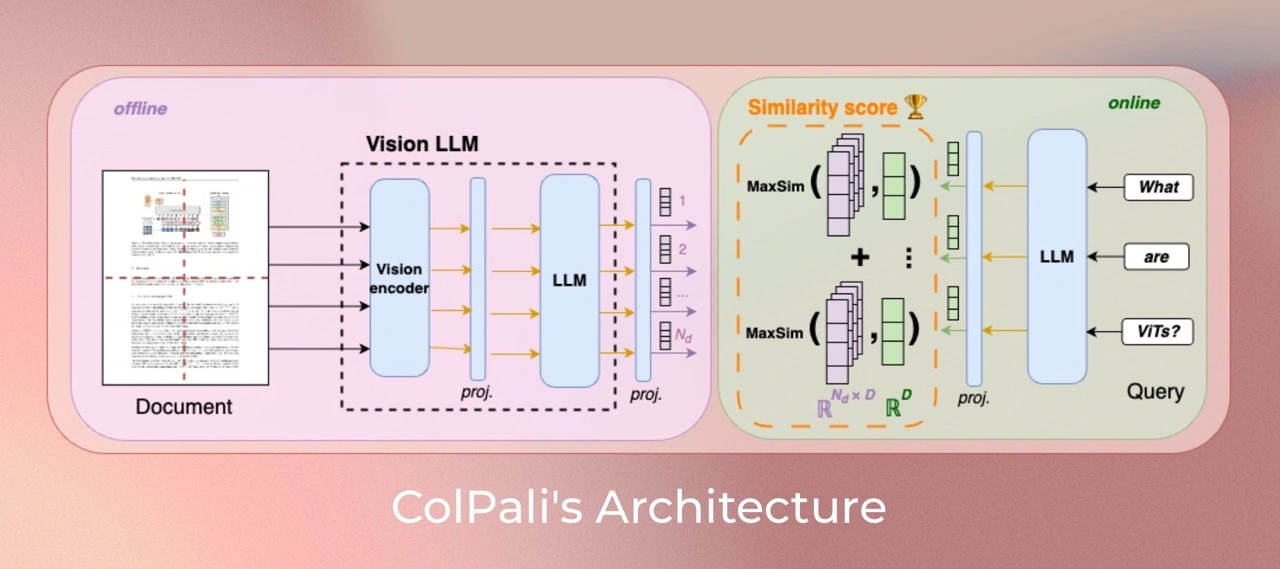
ColQwen3 is a model based on a novel model architecture and training strategy based on Vision Language Models (VLMs) to efficiently index documents from their visual features. It is a Qwen3-VL-2B extension that generates ColBERT- style multi-vector representations of text and images. It was introduced in the paper ColPali: Efficient Document Retrieval with Vision Language Models and first released in my repository
Version specificity
This model takes dynamic image resolutions in input and does not resize them, changing their aspect ratio as in ColPali. Maximal resolution is set so that 768 image patches are created at most. Experiments show clear improvements with larger amounts of image patches, at the cost of memory requirements.
This version is trained with colpali-engine==0.3.14.
Data is the same as the ColPali data described in the paper.
🔥Qwen3-VL-2B-Instruct Model Architecture Updates:
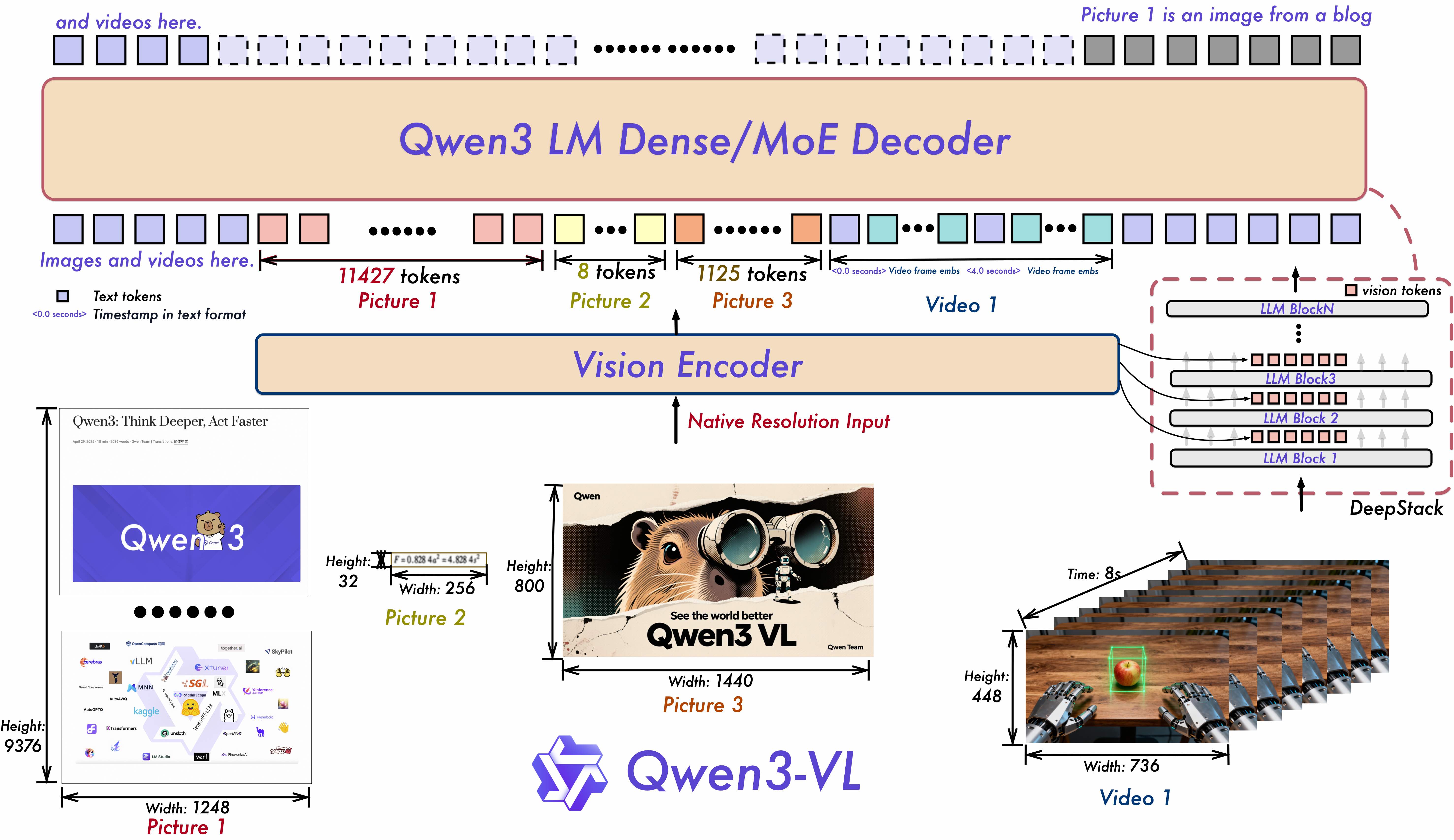
Interleaved-MRoPE: Full‑frequency allocation over time, width, and height via robust positional embeddings, enhancing long‑horizon video reasoning.
DeepStack: Fuses multi‑level ViT features to capture fine‑grained details and sharpen image–text alignment.
Text–Timestamp Alignment: Moves beyond T‑RoPE to precise, timestamp‑grounded event localization for stronger video temporal modeling.
This is the weight repository for Qwen3-VL-2B-Instruct.
Model Training
Dataset
Our training dataset of 127,460 query-page pairs is comprised of train sets of openly available academic datasets (63%) and a synthetic dataset made up of pages from web-crawled PDF documents and augmented with VLM-generated (Claude-3 Sonnet) pseudo-questions (37%). Our training set is fully English by design, enabling us to study zero-shot generalization to non-English languages. We explicitly verify no multi-page PDF document is used both ViDoRe and in the train set to prevent evaluation contamination. A validation set is created with 2% of the samples to tune hyperparameters.
Note: Multilingual data is present in the pretraining corpus of the language model and most probably in the multimodal training.
Parameters
All models are trained for 5 epochs on the train set. Unless specified otherwise, we train models in bfloat16 format, use low-rank adapters (LoRA)
with alpha=32 and r=32 on the transformer layers from the language model,
as well as the final randomly initialized projection layer, and use a paged_adamw_8bit optimizer.
We train on 2*NVIDIA A100 80GB GPUs setup with data parallelism, a learning rate of 5e-5 with linear decay with 2.5% warmup steps, and a batch size of 64.
ColQwen3-v0.1 Test Results
⚙️I used mteb to evaluate my ColQwen3-v0.1 retriever on the ViDoRe benchmark.
| Model | ArxivQ | DocQ | InfoQ | TabF | TATQ | Shift | AI | Energy | Gov. | Health. | Avg. |
|---|---|---|---|---|---|---|---|---|---|---|---|
Unstructured (text-only) |
|||||||||||
| - BM25 | - | 34.1 | - | - | 44.0 | 59.6 | 90.4 | 78.3 | 78.8 | 82.6 | - |
| - BGE-M3 | - | 28.4 (↓5.7) | - | - | 36.1 (↓7.9) | 68.5 (↑8.9) | 88.4 (↓2.0) | 76.8 (↓1.5) | 77.7 (↓1.1) | 84.6 (↑2.0) | - |
Unstructured + OCR |
|||||||||||
| - BM25 | 31.6 | 36.8 | 62.9 | 46.5 | 62.7 | 64.3 | 92.8 | 85.9 | 83.9 | 87.2 | 65.5 |
| - BGE-M3 | 31.4 (↓0.2) | 25.7 (↓11.1) | 60.1 (↓2.8) | 70.8 (↑24.3) | 50.5 (↓12.2) | 73.2 (↑8.9) | 90.2 (↓2.6) | 83.6 (↓2.3) | 84.9 (↑1.0) | 91.1 (↑3.9) | 66.1 (↑0.6) |
Unstructured + Captioning |
|||||||||||
| - BM25 | 40.1 | 38.4 | 70.0 | 35.4 | 61.5 | 60.9 | 88.0 | 84.7 | 82.7 | 89.2 | 65.1 |
| - BGE-M3 | 35.7 (↓4.4) | 32.9 (↓5.4) | 71.9 (↑1.9) | 69.1 (↑33.7) | 43.8 (↓17.7) | 73.1 (↑12.2) | 88.8 (↑0.8) | 83.3 (↓1.4) | 80.4 (↓2.3) | 91.3 (↑2.1) | 67.0 (↑1.9) |
| Contrastive VLMs | |||||||||||
| Jina-CLIP | 25.4 | 11.9 | 35.5 | 20.2 | 3.3 | 3.8 | 15.2 | 19.7 | 21.4 | 20.8 | 17.7 |
| Nomic-vision | 17.1 | 10.7 | 30.1 | 16.3 | 2.7 | 1.1 | 12.9 | 10.9 | 11.4 | 15.7 | 12.9 |
| SigLIP (Vanilla) | 43.2 | 30.3 | 64.1 | 58.1 | 26.2 | 18.7 | 62.5 | 65.7 | 66.1 | 79.1 | 51.4 |
| SigLIP (Vanilla) | 43.2 | 30.3 | 64.1 | 58.1 | 26.2 | 18.7 | 62.5 | 65.7 | 66.1 | 79.1 | 51.4 |
| BiSigLIP (+fine-tuning) | 58.5 (↑15.3) | 32.9 (↑2.6) | 70.5 (↑6.4) | 62.7 (↑4.6) | 30.5 (↑4.3) | 26.5 (↑7.8) | 74.3 (↑11.8) | 73.7 (↑8.0) | 74.2 (↑8.1) | 82.3 (↑3.2) | 58.6 (↑7.2) |
| BiPali (+LLM) | 56.5 (↓2.0) | 30.0 (↓2.9) | 67.4 (↓3.1) | 76.9 (↑14.2) | 33.4 (↑2.9) | 43.7 (↑17.2) | 71.2 (↓3.1) | 61.9 (↓11.7) | 73.8 (↓0.4) | 73.6 (↓8.8) | 58.8 (↑0.2) |
| ColPali (+Late Inter.) | 79.1 (↑22.6) | 54.4 (↑24.5) | 81.8 (↑14.4) | 83.9 (↑7.0) | 65.8 (↑32.4) | 73.2 (↑29.5) | 96.2 (↑25.0) | 91.0 (↑29.1) | 92.7 (↑18.9) | 94.4 (↑20.8) | 81.3 (↑22.5) |
| Ours | |||||||||||
| Colqwen3-v0.1 (+Late Inter.) | 80.1 (↑1.0) | 55.8 (↑1.4) | 86.7 (↑5.9) | 82.1 (↓1.8) | 70.8 (↑5.0) | 75.9 (↑2.7) | 99.1 (↑2.9) | 95.6 (↑4.6) | 96.1 (↑3.4) | 96.8 (↑2.4) | 83.9 (↑2.6) |
| Colqwen3-v0.2 (+Late Inter.) | 85.7 (↑6.6) | 54.6 (↑0.2) | 86.2 (↑5.4) | 87.3 (↑3.4) | 75.8 (↑10.0) | 82.0 (↑9.8) | 99.1 (-) | 95.3 (↑4.3) | 93.5 (↑0.8) | 96.6 (↑2.2) | 85.6 (↑4.3) |
Usage 🤗
Make sure colpali-engine is installed from source or with a version superior to 0.3.4.
transformers version must be >= 4.57.1.(compatible with Qwen3-VL interface)
pip install git+https://github.com/Mungeryang/colqwen3
import torch
from PIL import Image
from transformers.utils.import_utils import is_flash_attn_2_available

from colpali_engine.models import ColQwen3, ColQwen3Processor

model = ColQwen3.from_pretrained(
    "goodman2001/colqwen3-v0.1",
    torch_dtype=torch.bfloat16,
    device_map="cuda:0",  # or "mps" if on Apple Silicon
    attn_implementation="flash_attention_2" if is_flash_attn_2_available() else None,
).eval()
processor = ColQwen3Processor.from_pretrained("goodman2001/colqwen3-v0.1")

# Your inputs
images = [
    Image.new("RGB", (128, 128), color="white"),
    Image.new("RGB", (64, 32), color="black"),
]
queries = [
    "Is attention really all you need?",
    "What is the amount of bananas farmed in Salvador?",
]

# Process the inputs
batch_images = processor.process_images(images).to(model.device)
batch_queries = processor.process_queries(queries).to(model.device)

# Forward pass
with torch.no_grad():
    image_embeddings = model(**batch_images)
    query_embeddings = model(**batch_queries)

scores = processor.score_multi_vector(query_embeddings, image_embeddings)
Limitations
- Focus: The model primarily focuses on PDF-type documents and high-ressources languages, potentially limiting its generalization to other document types or less represented languages.
- Support: The model relies on multi-vector retreiving derived from the ColBERT late interaction mechanism, which may require engineering efforts to adapt to widely used vector retrieval frameworks that lack native multi-vector support.
License
ColQwen3's vision language backbone model (Qwen3-VL is under apache2.0 license. The adapters attached to the model are under MIT license.
Contact
- Mungeryang: mungerygm@gmail.com/yangguimiao@iie.ac.cn
Acknowledgments
❤️❤️❤️
Thanks to the Colpali team and Qwen team for their excellent open-source works! I accomplished this work by standing on the shoulders of giants~
👆👍
Citation
If you use any datasets or models from this organization in your research, please cite the original dataset as follows:
@misc{faysse2024colpaliefficientdocumentretrieval,
  title={ColPali: Efficient Document Retrieval with Vision Language Models},
  author={Manuel Faysse and Hugues Sibille and Tony Wu and Bilel Omrani and Gautier Viaud and Céline Hudelot and Pierre Colombo},
  year={2024},
  eprint={2407.01449},
  archivePrefix={arXiv},
  primaryClass={cs.IR},
  url={https://arxiv.org/abs/2407.01449},
}