

FLAM: Frame-Wise Language-Audio Modeling
Paper • 2505.05335 • Published





FLAM is a cutting-edge language–audio model that supports both zero-shot sound even detection and large-scale audio retrieval via free-form text.
This code accompanies the following ICML 2025 publication:
@inproceedings{flam2025,
    title={{FLAM}: Frame-Wise Language-Audio Modeling},
    author={Yusong Wu and Christos Tsirigotis and Ke Chen and Cheng-Zhi Anna Huang and Aaron Courville and Oriol Nieto and Prem Seetharaman and Justin Salamon},
    booktitle={Forty-second International Conference on Machine Learning (ICML)},
    year={2025},
    url={https://openreview.net/forum?id=7fQohcFrxG}
}
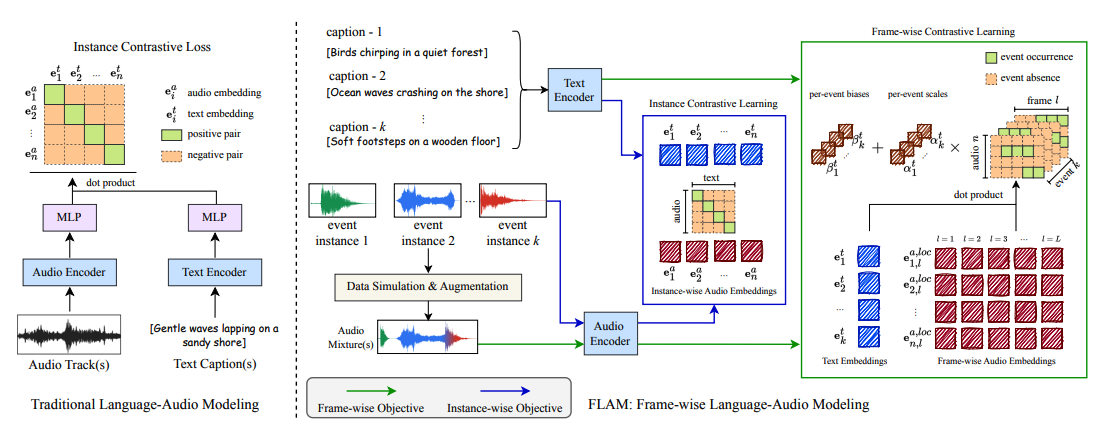
FLAM is based on contrastive language-audio pretraining, known as CLAP, and improve its capability by supporting the frame-wise event localization via learnable text and audio biases and scales.
Install FLAM via PyPi:
pip install openflam
Two examples are provided:
For the API documentation, please refer to hook.py.
Please refer to global_example.py:
import librosa
import torch

import openflam

DEVICE = "cuda" if torch.cuda.is_available() else "cpu"
SR = 48000  # Sampling Rate (FLAM requires 48kHz)

flam = openflam.OpenFLAM(model_name="v1-base", default_ckpt_path="/tmp/openflam").to(
    DEVICE
)

# Sanity Check (Optional)
flam.sanity_check()

# load audio
audio, sr = librosa.load("test/test_data/test_example.wav", sr=SR)
audio = audio[: int(10 * sr)]
audio_samples = torch.tensor(audio).unsqueeze(0).to(DEVICE)  # [B, 480000 = 10 sec]

# Define text
text_samples = [
    "breaking bones",
    "metallic creak",
    "tennis ball",
    "troll scream",
    "female speaker",
]

# Get Global Audio Features (10sec = 0.1Hz embeddings)
audio_global_feature = flam.get_global_audio_features(audio_samples)  # [B, 512]

# Get Text Features
text_feature = flam.get_text_features(text_samples)  # [B, 512]

# Calculate similarity (dot product)
global_similarities = (text_feature @ audio_global_feature.T).squeeze(1)

print("\nGlobal Cosine Similarities:")
for text, score in zip(text_samples, global_similarities):
    print(f"{text}: {score.item():.4f}")
Please refer to local_example.py.
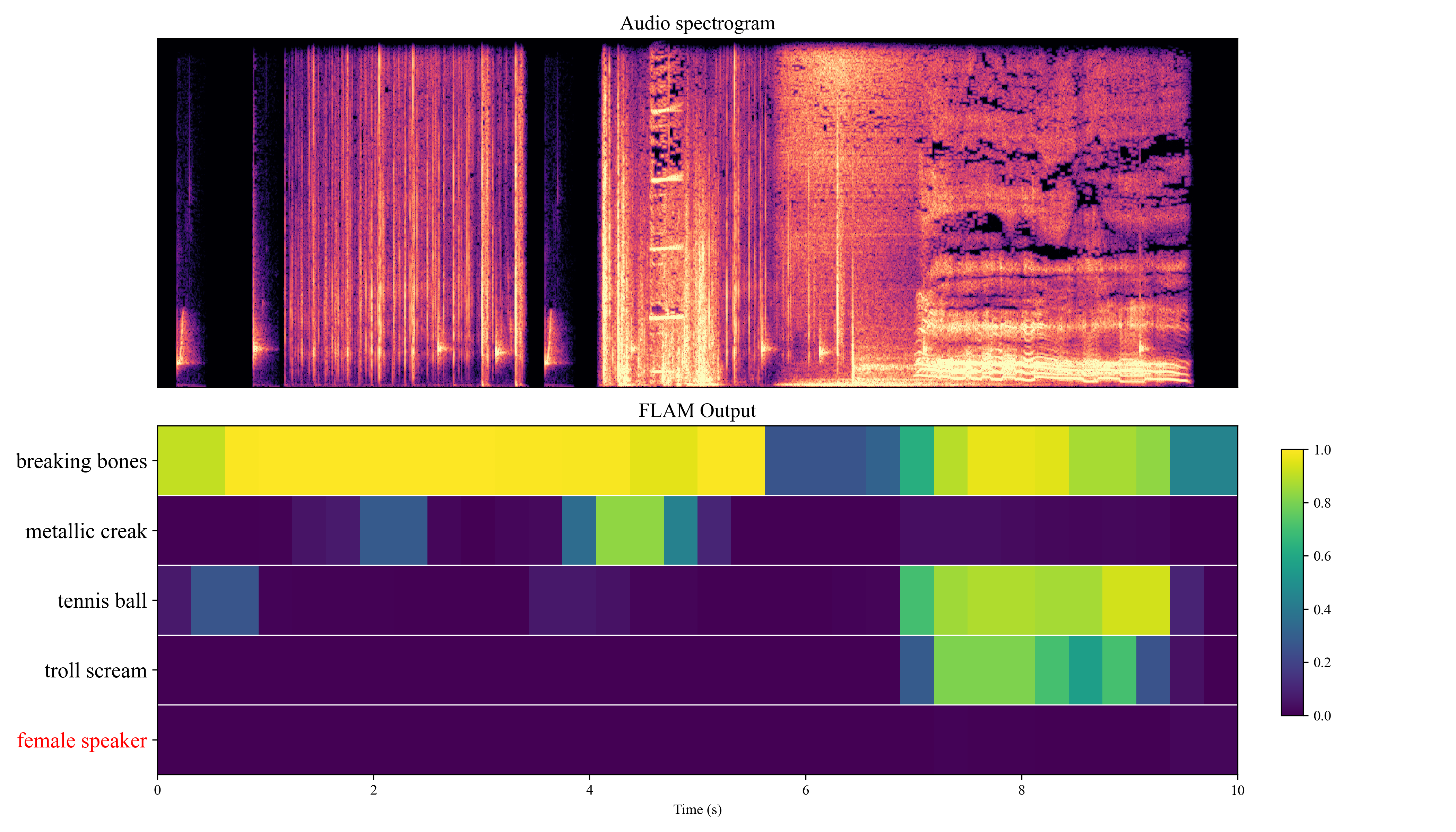
The following plot will be generated by running the code below:
from pathlib import Path

import librosa
import numpy as np
import scipy
import torch

import openflam
from openflam.module.plot_utils import plot_sed_heatmap

# Configuration
OUTPUT_DIR = Path("sed_output")  # Directory to save output figures

# Define target sound events
TEXTS = [
    "breaking bones",
    "metallic creak",
    "tennis ball",
    "troll scream",
    "female speaker",
]

# Define negative class (sounds that shouldn't be in the audio)
NEGATIVE_CLASS = [
    "female speaker"
]

SR = 48000
DEVICE = "cuda" if torch.cuda.is_available() else "cpu"

flam = openflam.OpenFLAM(model_name="v1-base", default_ckpt_path="/tmp/openflam")
flam.to(DEVICE)

# Load and prepare audio
audio, sr = librosa.load("test/test_data/test_example.wav", sr=SR)
audio = audio[: int(10 * sr)]

# Convert to tensor and move to device
audio_tensor = torch.tensor(audio).unsqueeze(0).to(DEVICE)

# Run inference
with torch.no_grad():
    # Get local similarity using the wrapper's built-in method
    # This uses the unbiased method (Eq. 9 in the paper)
    act_map_cross = (
        flam.get_local_similarity(
            audio_tensor,
            TEXTS,
            method="unbiased",
            cross_product=True,
        )
        .cpu()
        .numpy()
    )

# Apply median filtering for smoother results
act_map_filter = []
for i in range(act_map_cross.shape[0]):
    act_map_filter.append(scipy.ndimage.median_filter(act_map_cross[i], (1, 3)))
act_map_filter = np.array(act_map_filter)

# Prepare similarity dictionary for plotting
similarity = {f"{TEXTS[i]}": act_map_filter[0][i] for i in range(len(TEXTS))}

# Prepare audio for plotting (resample to 32kHz)
target_sr = 32000
audio_plot = librosa.resample(audio, orig_sr=SR, target_sr=target_sr)

# Create output directory if it doesn't exist
OUTPUT_DIR.mkdir(exist_ok=True)

# Generate and save visualization
output_path = OUTPUT_DIR / "sed_heatmap.png"
plot_sed_heatmap(
    audio_plot,
    target_sr,
    post_similarity=similarity,
    duration=10.0,
    negative_class=NEGATIVE_CLASS,
    figsize=(14, 8),
    save_path=output_path,
)

print(f"Plot saved: {output_path}")
Both code and models for OpenFLAM are released under a non-commercial Adobe Research License. Please, review it carefully before using this technology.
The pretrained checkpoints can be found here.
OpenFLAM automatically handles the downloading of the checkpoint. Please, refer to the previous section for more details.
The original experimental results reported in our paper were obtained by the model trained on internal datasets that are not publicly shareable.
OpenFLAM is trained on all publicly available datasets, including:
We report a comparison of the OpenFLAM performance to the original paper report (the global retrieval metrics --ie, A2T and T2A-- are R@1 / R@5):

If you use OpenFLAM, please cite our main work:
@inproceedings{flam2025,
    title={{FLAM}: Frame-Wise Language-Audio Modeling},
    author={Yusong Wu and Christos Tsirigotis and Ke Chen and Cheng-Zhi Anna Huang and Aaron Courville and Oriol Nieto and Prem Seetharaman and Justin Salamon},
    booktitle={Forty-second International Conference on Machine Learning (ICML)},
    year={2025},
    url={https://openreview.net/forum?id=7fQohcFrxG}
}